 Our Client Reviews



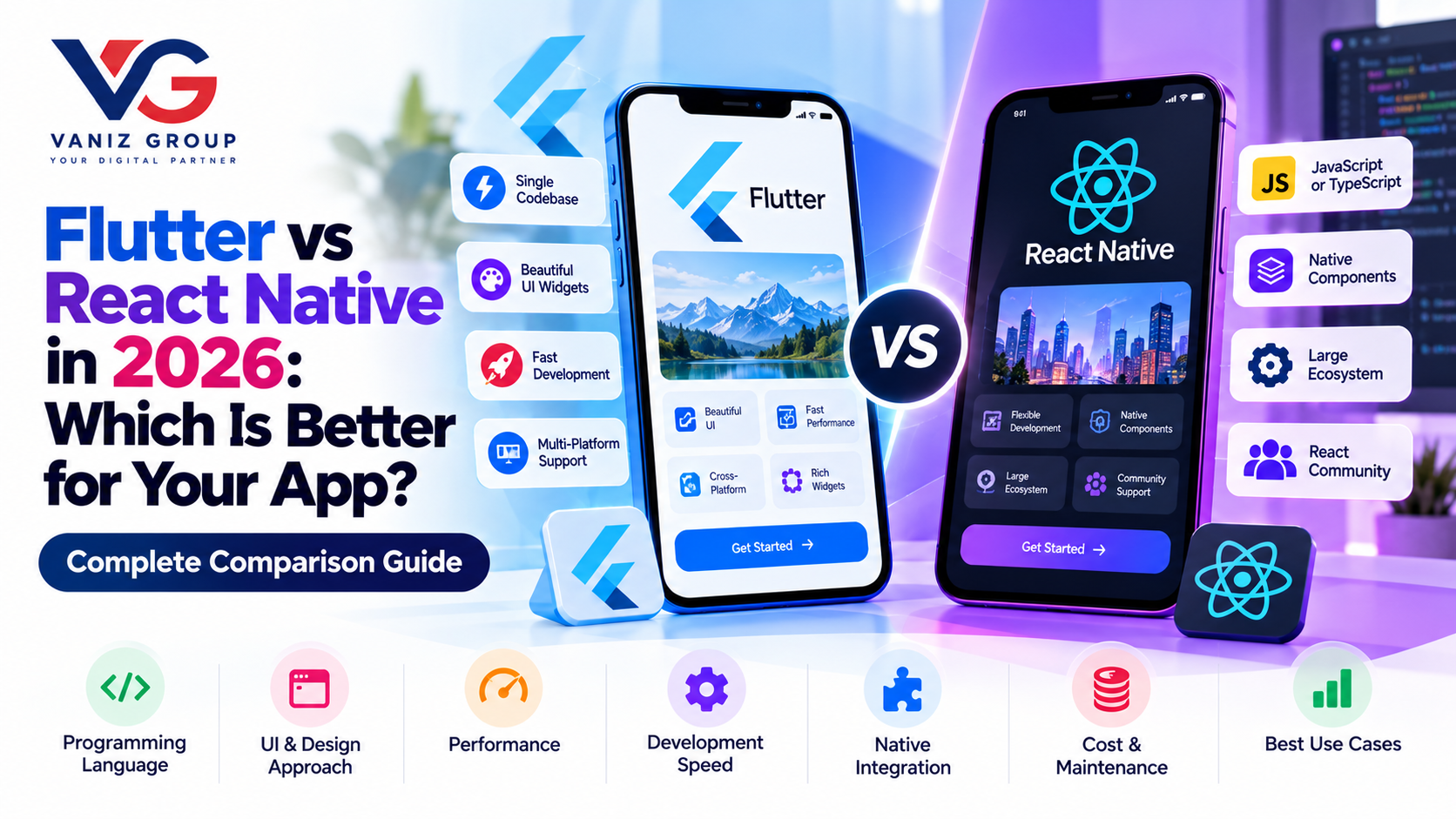
Flutter vs React Native in 2026: Which Is Better for Your App?
Choosing the right technology is one of the most important decisions when building a mobile application. The framework you select can affect development time, user experience, performance, maintenance costs, and how easily your app grows as your business expands.
In 2026, Flutter and React Native remain two popular options for cross-platform mobile app development. Both allow businesses to build Android and iOS applications while sharing a significant amount of code between platforms. However, they differ in programming language, user interface development, ecosystem, and development approach.
So, which is better: Flutter or React Native?
The answer depends on your app requirements, existing technology stack, team expertise, design expectations, and long-term business goals. This guide compares Flutter vs React Native across the factors that matter most to startups, small businesses, and established companies.
What Is Flutter?
Flutter is an open-source UI framework developed by Google. It uses the Dart programming language and allows developers to create applications for Android, iOS, web, desktop, and other supported platforms using a shared codebase.
One of Flutter's main strengths is its flexible approach to user interface development. It provides a rich collection of widgets and its own rendering system, giving developers detailed control over layouts, animations, colors, and interactions.
Flutter is particularly useful for applications that require consistent branding and a customized visual experience across different devices.
Key Features of Flutter
Single codebase for multiple supported platforms
Built-in Material Design and Cupertino-style widgets
Hot reload for faster development and iteration
Flexible UI customization and animation capabilities
Support for native platform integrations
Strong tooling for testing and debugging
Flutter can be a good choice for startups building a new product, businesses developing customer-facing applications, and companies that want a consistent design across Android and iOS.
What Is React Native?
React Native is an open-source framework originally developed by Meta. It enables developers to build mobile applications using JavaScript or TypeScript and React concepts.
React Native uses native platform components for much of its interface, allowing developers to create applications that align closely with Android and iOS conventions. It also supports native modules and platform-specific code when an application needs capabilities beyond its shared JavaScript or TypeScript codebase.
Its biggest advantage for many businesses is the ability to build on existing React and JavaScript knowledge. Teams that already maintain React-based websites or use a JavaScript backend may find it easier to adopt React Native.
Key Features of React Native
Shared code for Android and iOS applications
JavaScript and TypeScript support
Component-based development using React concepts
Access to native platform APIs and components
A broad ecosystem of libraries and development tools
Integration with existing JavaScript and React projects
React Native is often a strong option for businesses with React developers, products that need mobile and web coordination, or teams that want to reuse their JavaScript expertise.
Flutter vs React Native: Quick Comparison
Feature | Flutter | React Native |
|---|---|---|
Programming language | Dart | JavaScript or TypeScript |
UI approach | Flutter widgets and rendering | Native platform components with React |
UI customization | Excellent control over visual consistency | Flexible, with platform-native components |
Development speed | Fast with hot reload and reusable widgets | Fast with reusable components and React workflows |
Performance | Strong when well designed and optimized | Strong when well designed and optimized |
Native integration | Plugins and platform-specific code | Native modules and platform-specific code |
Existing React expertise | Limited direct reuse of React knowledge | Excellent fit for React teams |
Multiple-platform strategy | Mobile, web, desktop and other supported targets | Mobile-focused core framework; web often uses a separate React solution |
Best fit | Custom interfaces and consistent cross-platform design | React-based teams and native-component-oriented apps |
Neither framework is automatically better for every project. Your application's features, integrations, and development team can matter more than the framework's general reputation.
1. Programming Language: Dart vs JavaScript
The programming language is an important consideration because it affects hiring, onboarding, development practices, and long-term maintenance.
Flutter uses Dart
Dart is designed to support productive application development. Flutter developers use Dart for business logic, application state, networking, and UI composition.
Dart may require additional learning if your team primarily works with JavaScript, C#, Java, or Python. However, teams can become productive with it, particularly when the project has a clear architecture and development standards.
React Native uses JavaScript or TypeScript
JavaScript is widely used in web development, while TypeScript adds static typing that can improve code quality and maintainability.
For companies already using React, Next.js, Node.js, or other JavaScript technologies, React Native can reduce the learning curve. Developers may also be able to reuse some validation rules, business logic, and API-related code where the requirements are compatible.
Which is better? React Native often has an advantage when your team already knows React and JavaScript. Flutter can be a strong choice when you are starting with a dedicated cross-platform development team and want a consistent application architecture.
2. UI Design and Customization
The user interface influences how customers perceive your product and how easily they complete important tasks.
Flutter for highly customized interfaces
Flutter provides extensive control over how application screens are rendered. Developers can create custom navigation, dashboards, charts, transitions, animations, and branded components.
This makes Flutter attractive for fintech apps, booking platforms, healthcare applications, e-commerce products, and other applications where the design needs to look consistent across Android and iOS.
React Native for platform-oriented interfaces
React Native uses native platform components for much of its UI. This can be useful when an application should follow familiar platform conventions or integrate closely with existing native UI patterns.
Developers can still create customized designs, but they need to consider platform differences and test their components across supported devices.
Which is better? Flutter is often a good fit for highly customized and visually consistent interfaces. React Native can be preferable when native platform conventions and an existing React workflow are priorities.
3. Performance: Flutter vs React Native
Performance affects loading time, scrolling, animations, responsiveness, battery use, and the overall customer experience.
Flutter compiles Dart code to native machine code for supported mobile targets and uses its rendering engine to draw the interface. This can provide predictable rendering behavior, particularly for custom and animation-heavy screens.
React Native has evolved significantly through its New Architecture, which improves how JavaScript interacts with native components. Its architecture and JavaScript engine have continued to develop, making it a capable option for many production applications.
However, real-world performance depends on more than the framework. Network latency, database queries, image sizes, memory use, application architecture, third-party packages, and device capabilities can all affect results.
Which is better? Both can deliver excellent performance. For applications involving complex animations or custom rendering, Flutter is worth evaluating closely. For applications built around native components and a React-based stack, React Native may be equally suitable.
Always benchmark a working prototype on representative low-end and high-end devices before making a final decision.
4. Development Speed and Productivity
Businesses often choose cross-platform frameworks to reduce duplicated work and launch on multiple platforms more efficiently.
Flutter offers hot reload, reusable widgets, and a consistent UI toolkit. These capabilities help teams iterate quickly on layouts and interactions.
React Native offers fast refresh, reusable React components, and access to a mature JavaScript ecosystem. Teams familiar with React may be able to start development quickly without learning a new UI programming model.
Actual delivery time depends on project complexity, design readiness, backend APIs, integrations, testing requirements, and the experience of the team.
Which is better? React Native may provide a faster start for an experienced React team. Flutter can be highly productive for teams building a new application with a shared design system and reusable widgets.
5. Libraries, Plugins, and Native Integrations
Most production apps need more than screens. They may require push notifications, maps, payment gateways, camera access, biometrics, analytics, Bluetooth, background tasks, or third-party authentication.
Flutter offers packages through its ecosystem and supports native integrations through platform-specific code when required.
React Native provides npm-based libraries and supports native modules and native components. Some integrations may be especially convenient when a suitable React Native library already exists.
In either ecosystem, package quality varies. A library's popularity alone does not guarantee that it is actively maintained or compatible with your target versions.
Before choosing a framework, verify that your essential integrations support the required platforms and versions. Check maintenance activity, licensing, documentation, security, and migration requirements.
Which is better? Neither has a universal advantage. React Native may be more convenient for a JavaScript-heavy product, while Flutter may suit teams that prefer a cohesive UI framework. The deciding factor is whether your app's critical integrations are well supported.
6. Cost of Development: Flutter vs React Native
Both frameworks can reduce the effort required to develop separate Android and iOS applications. However, neither guarantees that your project will be inexpensive.
The total budget depends on the features, design complexity, backend development, integrations, security requirements, testing, and ongoing maintenance.
For early planning, the following are illustrative estimates in US dollars, not fixed market prices or quotations.
Project type | Illustrative development range |
|---|---|
Basic MVP | $5,000–$15,000 |
Mid-level business app | $15,000–$40,000 |
Advanced application | $40,000–$100,000+ |
A simple application with authentication, a few screens, and basic API integration will generally require less work than a product with real-time tracking, video calling, complex financial workflows, offline synchronization, or multiple user roles.
Cross-platform development can reduce duplicated implementation, but some native development may still be required. Backend systems, hosting, third-party subscriptions, app-store accounts, and ongoing support should also be included in your budget.
Which is cheaper? There is no consistent winner. React Native may reduce onboarding costs for an existing React team. Flutter may reduce UI implementation effort for certain custom-designed applications. Request estimates based on the same feature list before comparing proposals.
7. Scalability and Long-Term Maintenance
Scalability means more than supporting a growing number of users. A maintainable app should also support new features, integrations, developers, and platform updates without becoming difficult to change.
Flutter applications benefit from reusable widgets, clear separation of concerns, and well-defined application architecture.
React Native applications benefit from reusable components, TypeScript, modular architecture, and established React development practices.
Both frameworks can support large applications, but neither automatically creates scalable software. Poor state management, tightly coupled code, untested business logic, and unnecessary dependencies can create problems in either framework.
For a long-term product, plan for:
A clear folder and module structure
Reusable UI components
Consistent state management
Secure API communication and authentication
Automated testing and continuous integration
Crash reporting, analytics, and performance monitoring
Dependency updates and documented release procedures
Which is better? Both are suitable for long-term products when supported by sound engineering practices. The experience of your development team and the quality of the architecture are more important than the framework name alone.
8. Which Framework Is Better for Different App Types?
Your product requirements should guide the decision.
Choose Flutter for:
Apps with highly customized visual designs
Booking and reservation platforms
Fintech and dashboard-heavy applications
E-commerce apps requiring a consistent branded UI
Products targeting mobile and selected desktop or web platforms from a shared codebase
Startups creating a new product without an established React team
Choose React Native for:
Products with an existing React or JavaScript team
Businesses that already use React on the web
Applications built around native platform components
Products that can benefit from shared JavaScript or TypeScript business logic
Teams that want to build on established React development practices
These are starting points, not strict rules. Both frameworks can support many of the same application categories. Your required integrations, design, platform targets, and team's capabilities should decide the final choice.
9. Flutter vs React Native for Startups
For startups, the best framework is usually the one that helps validate the product efficiently without creating unnecessary long-term complexity.
If you are launching an MVP, start by defining the essential features. These might include user registration, profiles, a dashboard, payments, notifications, and API integration.
Then evaluate the frameworks against your actual requirements.
Flutter may suit a startup that wants a distinctive design and a consistent experience across Android and iOS. React Native may be a natural fit if the startup already has React developers or an existing JavaScript codebase.
Avoid choosing a framework solely because it is trending. A successful MVP depends on solving a real customer problem, delivering reliable core features, and collecting feedback quickly.
10. Common Mistakes When Choosing a Framework
Businesses sometimes focus too heavily on the framework comparison and overlook the practical requirements of the project.
Avoid these common mistakes:
Choosing based only on popularity: A popular framework is not necessarily the best fit for your product.
Ignoring native features: Verify camera, Bluetooth, background processing, biometrics, and other required device capabilities early.
Comparing only initial development cost: Consider maintenance, third-party services, testing, and future feature development.
Skipping device testing: Test on real devices with different screen sizes, operating system versions, and performance capabilities.
Using too many dependencies: Unnecessary packages can increase maintenance effort and compatibility risks.
Ignoring architecture: Good code organization and automated tests make future changes easier in either framework.
Delaying security planning: Authentication, authorization, data protection, secure storage, and API security should be included from the beginning.
Final Verdict: Flutter or React Native in 2026?
Flutter and React Native are both capable choices for cross-platform mobile app development in 2026. The better option depends on your business objectives, design requirements, technical team, integrations, and long-term roadmap.
Choose Flutter if you prioritize highly customized interfaces, visual consistency, and a cohesive multi-platform UI toolkit.
Choose React Native if your team already works with React and JavaScript or TypeScript, or if its native-component approach aligns well with your application.
If you are unsure, define your core features, list the essential integrations, and build a small proof of concept using the most important user journeys. Compare development effort, performance, usability, and maintenance implications before committing to a framework.
Build Your Next Mobile App With Vaniz Group
Planning a new mobile application for your business or startup? Vaniz Group helps businesses turn ideas into practical digital products through mobile app development, custom software development, API integration, and scalable application engineering.
Whether you are considering Flutter, React Native, or a different technology stack, the right approach begins with understanding your users, business goals, and technical requirements.
Contact Vaniz Group to discuss your app idea, define your MVP, and explore a development approach that fits your goals.
Visit: https://vanizgroup.com/contact-us
Frequently Asked Questions
1. Is Flutter better than React Native in 2026?
Neither is universally better. Flutter is often attractive for highly customized interfaces and consistent cross-platform UI. React Native can be especially convenient for teams with existing React and JavaScript expertise.
2. Which is faster, Flutter or React Native?
Both can deliver responsive applications. Actual performance depends on the app's architecture, rendering needs, device capabilities, third-party libraries, and optimization. Benchmarking a prototype is the most reliable way to compare them for a specific project.
3. Which framework is more affordable?
Costs depend on the scope of work and the development team's experience. React Native may be more economical for an established React team, while Flutter may reduce effort for some custom UI projects. Compare estimates using the same requirements.
4. Can Flutter and React Native build Android and iOS apps?
Yes. Both frameworks support building Android and iOS applications from a shared codebase, although some platform-specific code and testing may still be necessary.
5. Is Flutter suitable for large-scale applications?
Yes. Flutter can support large applications when the software is designed with appropriate architecture, testing, security, monitoring, and maintenance practices.
6. Can React Native use native device features?
Yes. React Native supports native modules and platform-specific implementations for device capabilities. The exact integration effort depends on the feature and the available libraries.
7. Can I switch frameworks after launching my app?
Yes, but moving an application from Flutter to React Native or the other way around may require substantial redevelopment. Some backend services, APIs, and business rules can be reused, but UI code and framework-specific logic generally need to be rebuilt.
8. How do I choose the right framework for my business?
Start with your required features, target platforms, integrations, timeline, budget, and available team expertise. A technical assessment or small proof of concept can help you make an informed decision before full development begins.