 Our Client Reviews


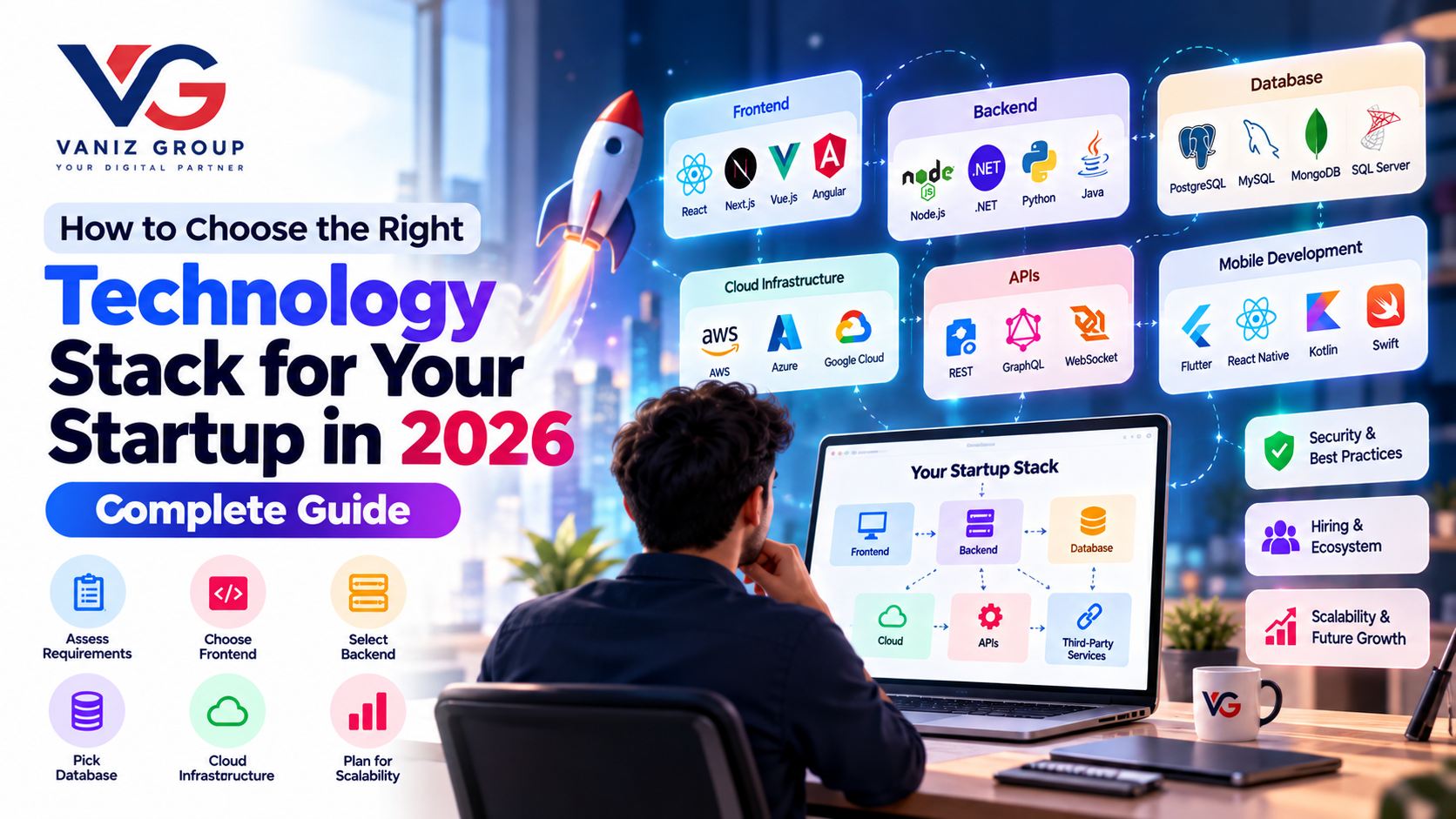
Choosing the right technology stack is one of the most important decisions when building a startup product. The technologies you select can affect development speed, performance, security, scalability, maintenance, hiring, and long-term development costs.
For a startup, the goal is not to choose the newest or most popular technology. The goal is to choose a technology stack that fits your product, budget, team, users, and growth plans.
In this guide, we'll explain how to choose the right technology stack for your startup in 2026, including frontend, backend, databases, cloud infrastructure, APIs, mobile development, security, AI integration, and scalability.
What Is a Technology Stack?
A technology stack is the collection of technologies used to build and operate a software product.
A modern startup product may include several layers:
Frontend → Backend/API → Database → Cloud Infrastructure → Third-Party Services
For example, a web application might use:
Frontend: React or Next.js
Backend: Node.js or ASP.NET Core
Database: PostgreSQL
Cloud: AWS or Azure
APIs: REST or GraphQL
Infrastructure: Docker and CI/CD
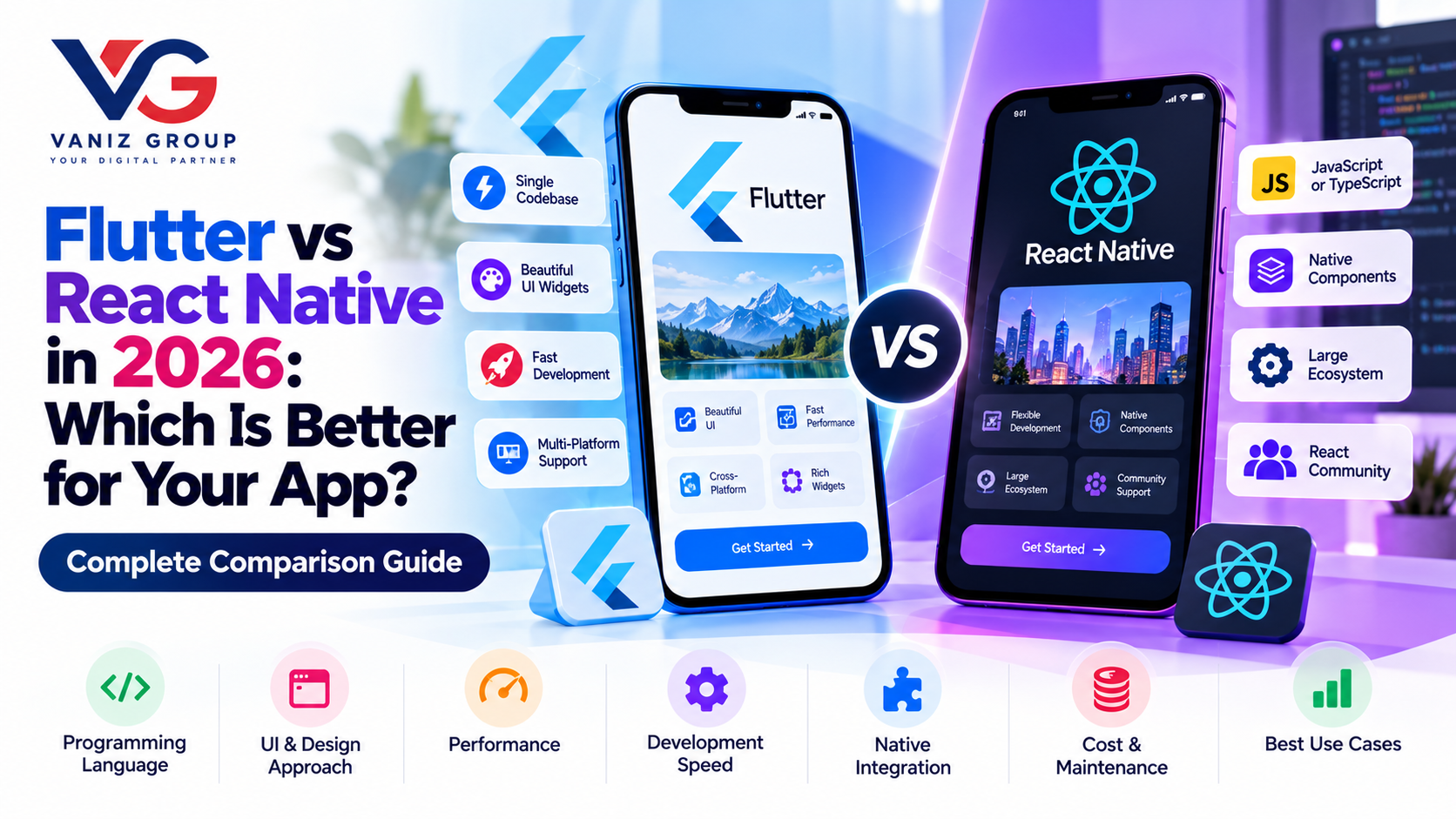
A mobile startup could use Flutter or React Native for the application while sharing a backend API with its web platform.
The right combination depends on the product requirements.
Why Is Choosing the Right Technology Stack Important?
Technology decisions made during the early stages can influence your startup for years.
Development Speed
The right technologies can help your team build and release an MVP faster.
Performance
The technology stack affects how efficiently your application handles users, requests, databases, and real-time operations.
Scalability
A startup may have only a few hundred users initially but could eventually serve thousands or millions.
Your architecture should provide a reasonable path for growth.
Development Cost
Technology choices can affect developer availability, infrastructure costs, third-party services, and maintenance requirements.
Security
Your technology stack should support secure authentication, authorization, encryption, data protection, monitoring, and updates.
Hiring
Choosing technologies with a strong developer ecosystem can make it easier to hire developers and expand your team.
How to Choose the Right Technology Stack for Your Startup
There is no universal technology stack that works for every startup.
Follow these steps before making a decision.
1. Start With Your Product Requirements
Don't start by asking:
"Which programming language should we use?"
Start with:
"What does our product need to do?"
Define:
Core features
Target users
Platforms
Expected traffic
Real-time requirements
Data requirements
Integrations
Security requirements
Business model
Future expansion plans
For example, a content website may have completely different requirements from a real-time trading platform or a multi-vendor marketplace.
2. Define Your MVP
Startups usually don't need every possible feature on day one.
Define the minimum viable product that can test your business idea.
For example, an online marketplace MVP might require:
User registration
Product listings
Search
Cart
Checkout
Payments
Order management
Admin dashboard
Advanced features such as AI recommendations, loyalty programs, complex analytics, and personalization can be added later.
A focused MVP can reduce initial development time and cost.
3. Choose the Right Frontend Technology
The frontend is the part of the application users interact with.
Common technologies include:
React
React is widely used for modern web applications and provides a large ecosystem of libraries and tools.
Next.js
Next.js can be useful for applications requiring modern React development, routing, server-side capabilities, performance optimization, and SEO-friendly pages.
Angular
Angular can be suitable for larger structured applications, particularly where teams prefer a comprehensive framework.
Vue.js
Vue can be a practical option for teams looking for a flexible frontend framework with a relatively approachable development model.
HTML, CSS and JavaScript
For smaller websites or simple interfaces, traditional web technologies may be sufficient.
The right choice depends on your product rather than popularity alone.
4. Choose Your Backend Technology
The backend handles business logic, APIs, authentication, database communication, integrations, and other server-side operations.
Popular choices include:
Node.js
Node.js is commonly used for API-driven applications, real-time applications, SaaS products, marketplaces, and startups that want JavaScript across the stack.
ASP.NET Core
ASP.NET Core is a strong option for secure, scalable business applications, enterprise systems, APIs, and applications built with C#.
Python
Python is widely used for AI, machine learning, data processing, automation, and backend development.
Java
Java remains a strong choice for large-scale applications, enterprise systems, financial platforms, and complex backend environments.
The best backend technology is usually the one that matches your application's requirements and your team's expertise.
5. Select the Right Database
Your database stores application data such as users, products, orders, transactions, messages, and business records.
Relational Databases
Common options include:
PostgreSQL
MySQL
SQL Server
These are suitable when your application requires structured data and relationships between entities.
For example:
Customers → Orders → Products → Payments
NoSQL Databases
Examples include:
MongoDB
DynamoDB
Other specialized NoSQL databases
These can be useful for certain flexible data structures, high-scale workloads, or specific application architectures.
The important question isn't simply SQL vs NoSQL.
Instead, ask:
What type of data does the application need to store, query, and manage?
6. Decide Between Web, Mobile or Cross-Platform Development
If you're building a mobile product, you need to decide how the application will be developed.
Native Development
Native Android and iOS development can provide deep access to platform-specific capabilities.
Technologies include:
Kotlin for Android
Swift for iOS
Flutter
Flutter can allow startups to build applications for multiple platforms from a shared codebase.
React Native
React Native is another popular cross-platform option, particularly for teams familiar with JavaScript and React.
.NET MAUI
.NET MAUI can be useful for teams already working heavily with the Microsoft and C# ecosystem.
For many startups, cross-platform development can reduce duplicated development effort, but native development may still be preferable when platform-specific performance or capabilities are critical.
7. Consider APIs and Third-Party Integrations
Modern applications rarely operate independently.
You may need integrations with:
Payment gateways
Maps
Email services
SMS providers
Authentication services
Cloud storage
Shipping providers
Accounting platforms
CRM systems
Analytics platforms
AI services
Social login providers
Design your application around well-defined APIs so that integrations can be maintained as the product evolves.
8. Choose the Right Cloud Platform
Cloud infrastructure provides the resources required to run your application.
Popular options include:
AWS
Microsoft Azure
Google Cloud
A startup might use cloud services for:
Application hosting
Databases
File storage
Backups
Monitoring
Networking
Authentication
Serverless workloads
Containers
Content delivery
You don't necessarily need a highly complicated cloud architecture on day one.
Start with what your MVP requires and scale infrastructure as usage grows.
9. Think About Scalability From the Beginning
You don't need to build a million-user architecture for a product that hasn't launched.
However, you should avoid decisions that make future growth unnecessarily difficult.
Consider:
API architecture
Database structure
Caching
Background jobs
Load balancing
File storage
CDN
Horizontal scaling
Monitoring
Database optimization
A good startup architecture should provide a practical path from MVP to a larger production system.
10. Prioritize Security
Security shouldn't be added after development is finished.
Your technology stack should support:
Secure authentication
Role-based access control
Password protection
Data encryption
API security
Input validation
Secure payments
Access control
Logging
Monitoring
Regular dependency updates
Backups
If your application handles sensitive information, security and regulatory requirements should influence technology decisions from the beginning.
11. Consider AI Requirements
AI has become part of many modern startup products.
If your startup plans to use AI, consider whether you'll need:
LLM APIs
AI agents
RAG
Vector databases
Embeddings
Machine learning models
AI-powered search
Recommendation systems
Document processing
AI automation
For example, a customer support platform might combine:
React/Next.js → Node.js → PostgreSQL → AI API → Vector Search → Cloud Infrastructure
AI shouldn't automatically determine your entire technology stack. Instead, it should be integrated where it creates measurable value.
12. Think About Development Team Skills
Your team's experience is one of the most important factors.
Suppose your developers have strong experience with:
C# + ASP.NET Core + React + SQL Server
Switching to a completely unfamiliar technology simply because it is trending may slow down development.
A technology that your team knows well can often produce better results than a theoretically perfect technology that nobody knows.
13. Consider Hiring and Talent Availability
Your startup may eventually need:
Backend developers
Frontend developers
Mobile developers
DevOps engineers
QA engineers
AI/ML engineers
Choose technologies that give you reasonable access to skilled developers in your target hiring market.
A technology with a strong ecosystem can reduce hiring and maintenance challenges.
14. Think About Long-Term Maintenance
Building the application is only the beginning.
You will eventually need to:
Fix bugs
Update dependencies
Improve performance
Add features
Upgrade infrastructure
Monitor security
Integrate new services
Support new devices and browsers
Avoid selecting technologies purely because they are new.
Stability, ecosystem, documentation, community support, and maintainability matter.
Recommended Technology Stacks for Different Startup Products
There is no single perfect stack, but the following combinations can work well for different scenarios.
Startup Type | Possible Technology Stack |
|---|---|
Business Website | Next.js + Node.js + PostgreSQL |
SaaS Platform | React/Next.js + Node.js/ASP.NET Core + PostgreSQL |
E-Commerce | React/Next.js + Node.js/ASP.NET Core + PostgreSQL |
Marketplace | React/Next.js + Node.js/ASP.NET Core + PostgreSQL |
Mobile App | Flutter/React Native + REST/GraphQL API |
Enterprise Software | Angular/React + ASP.NET Core + SQL Server |
AI Application | React/Next.js + Node.js/Python + PostgreSQL + AI APIs |
Real-Time Application | React/Next.js + Node.js + WebSockets + PostgreSQL |
Content Platform | Next.js + Node.js + PostgreSQL + CDN |
These are examples, not mandatory architectures. Your actual stack should be selected after analyzing your requirements.
Monolithic vs Microservices Architecture
One common question startups face is whether they should build a monolith or microservices architecture.
Monolithic Architecture
A monolithic application keeps most application functionality within a single deployable system.
It can be easier to:
Develop
Test
Deploy
Maintain
For many startups, a well-structured monolith is a practical choice for an MVP.
Microservices Architecture
Microservices divide the application into independently deployable services.
They can provide benefits for larger systems with complex teams and workloads, but they also introduce additional operational complexity.
For most early-stage startups, starting simple and introducing service separation when there is a real need can be more practical than adopting microservices from day one.
How Much Does It Cost to Build a Startup Product?
Technology stack alone doesn't determine development cost.
Other factors include:
Number of features
Platforms
UI/UX complexity
Backend complexity
Third-party integrations
AI functionality
Security requirements
Development team
Testing
Infrastructure
Maintenance
As a broad planning estimate:
Product Type | Approximate Development Range |
|---|---|
Simple MVP | $8,000–$20,000 |
Medium Startup Product | $20,000–$50,000 |
Advanced Platform | $50,000–$120,000+ |
Complex Enterprise Product | $120,000+ |
These are general estimates. A detailed technical specification is required for a more accurate project estimate.
Common Technology Stack Mistakes Startups Should Avoid
Choosing Technology Because It Is Trending
Popular doesn't always mean suitable.
Using Too Many Technologies
More technologies can mean more complexity, maintenance, and hiring requirements.
Building for Millions of Users Too Early
Start with a scalable foundation rather than overengineering the MVP.
Ignoring Security
Security problems are much more expensive to fix after launch.
Choosing Based Only on Development Cost
A cheap initial stack can become expensive if it creates maintenance or scalability problems.
Ignoring Your Development Team
The team's existing knowledge should be part of the decision.
Not Planning Integrations
Third-party services should be considered before architecture decisions are finalized.
Overengineering the MVP
Your first goal should be to validate the product and business model, not build every possible feature.
How to Make the Final Technology Stack Decision
Before finalizing your stack, evaluate each technology based on:
Product requirements
MVP scope
Development speed
Team expertise
Scalability
Performance
Security
Developer availability
Ecosystem and community
Maintenance
Integration requirements
Infrastructure costs
Long-term business goals
A technology decision should support the business strategy, not just the technical strategy.
Final Thoughts
Choosing the right technology stack is one of the most important technical decisions a startup can make, but there is no universal answer.
The best technology stack is the one that allows you to build your MVP efficiently, deliver a good user experience, maintain security, control costs, and scale when your business grows.
Start with your product requirements, select technologies that match your team's capabilities, avoid unnecessary complexity, and build an architecture that can evolve.
Most importantly, don't choose technology simply because it is popular. Choose it because it solves your business and technical requirements effectively.
Build Your Startup Product With Vaniz Group
At Vaniz Group, we help startups turn ideas into scalable digital products, from MVP development and web applications to mobile apps, SaaS platforms, APIs, AI-powered applications, and custom business software.
Our development capabilities include Node.js, ASP.NET Core, C#, React, Angular, Next.js, Flutter, .NET MAUI, SQL/NoSQL databases, AWS, Azure, Docker, APIs, AI integrations, and cloud deployment.
If you're planning a startup product and aren't sure which technology stack to choose, Vaniz Group can help you evaluate your requirements and select an architecture designed around your product, budget, and growth plans.