 Our Client Reviews


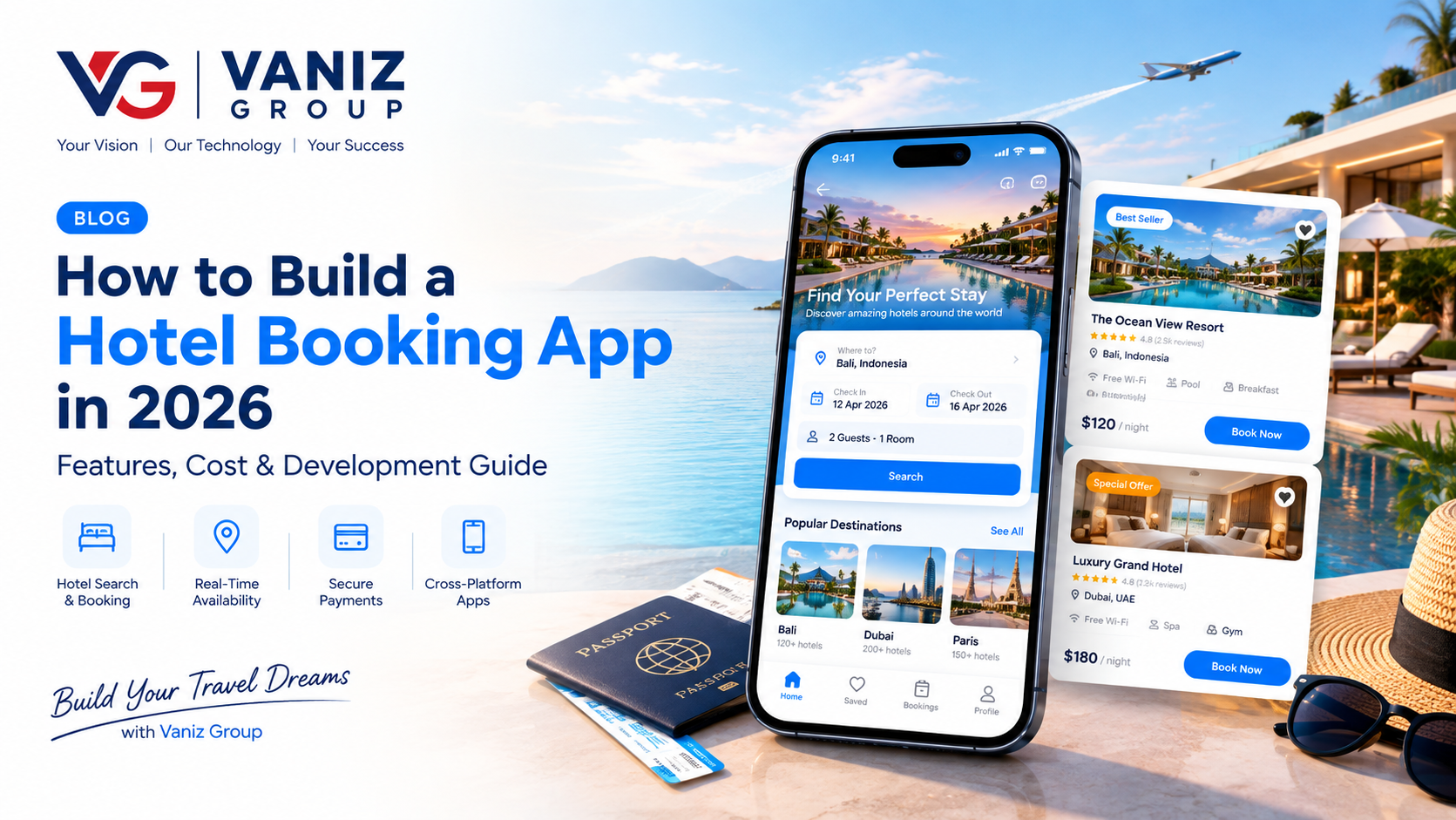
The hotel booking industry has become highly digital, and travelers now expect to search hotels, compare rooms, check availability, make secure payments, and manage bookings directly from their smartphones. For businesses entering the travel technology market, a hotel booking app can provide an opportunity to build a scalable marketplace, hotel reservation platform, or direct-booking solution.
But building a successful hotel booking app requires more than creating attractive screens. You need real-time availability, hotel and room data, payment integration, booking management, notifications, secure APIs, and a backend architecture capable of handling large numbers of users.
In this guide, we explain how to build a hotel booking app in 2026, including its key features, technology stack, API integrations, development process, estimated cost, timeline, and scalability considerations.
What Is a Hotel Booking App?
A hotel booking app is a mobile or web application that allows users to discover hotels, compare rooms and prices, check availability, and make reservations online.
Depending on the business model, the platform can connect travelers with:
Hotels
Resorts
Apartments
Hostels
Guest houses
Vacation properties
Boutique accommodations
A hotel booking platform can operate as a marketplace with multiple hotel partners or as a direct booking application for a hotel chain.
How Does a Hotel Booking App Work?
A typical hotel booking application follows a simple user journey:
The user enters a destination and travel dates.
The application searches available properties.
Hotels and rooms are displayed with prices, ratings, images, and amenities.
The user applies filters and compares options.
The user selects a hotel and room.
Guest details are entered.
Payment is processed securely.
The booking is confirmed.
The user receives confirmation and notifications.
The booking can later be modified or cancelled according to the property's policies.
Behind this simple experience is a complex system involving APIs, databases, payment services, hotel inventory, pricing systems, notifications, and administrative tools.
Key Features of a Hotel Booking App
A successful hotel booking app should provide a smooth experience for travelers while giving hotels and administrators enough control to manage their inventory.
1. User Registration and Login
Users should be able to create accounts using email, phone number, or supported social login options.
The user profile can contain:
Personal information
Saved hotels
Previous bookings
Upcoming trips
Payment preferences
Reviews
Loyalty information
2. Hotel Search
Search is one of the most important parts of a hotel booking application.
Users should be able to search by:
City
Destination
Hotel name
Location
Check-in date
Check-out date
Number of guests
Number of rooms
Fast search results are important because users often compare multiple properties before making a decision.
3. Location-Based Search
Integrating maps and location services can help users discover hotels near specific places.
For example, users may search for hotels near:
Airports
Tourist attractions
Business districts
Railway stations
Beaches
Shopping areas
Conference centers
4. Filters and Sorting
Users should be able to narrow results based on their preferences.
Common filters include:
Price
Star rating
Guest rating
Hotel type
Amenities
Distance
Room type
Breakfast availability
Free cancellation
Sorting options can include price, rating, popularity, and distance.
5. Hotel Details
Each hotel should have a detailed profile containing:
Hotel name
Photos
Description
Address
Map location
Amenities
Room types
Prices
Cancellation policies
Guest reviews
Check-in and check-out information
High-quality hotel information helps users make confident booking decisions.
6. Room Selection
Users should be able to compare available rooms and select the option that best fits their needs.
Room information may include:
Room type
Occupancy
Bed type
Room size
Amenities
Meal options
Price
Cancellation policy
Availability
7. Real-Time Availability
Real-time inventory is critical for hotel booking platforms.
The application should display whether rooms are currently available and avoid accepting bookings for rooms that have already been sold.
This usually requires integration with hotel APIs, channel managers, property management systems, or other inventory providers.
8. Secure Online Payments
The application should support secure payment processing through suitable payment gateways.
Depending on the target market, businesses may support:
Credit and debit cards
Digital wallets
Bank payments
Local payment methods
Other supported online payment options
The platform should also handle payment confirmation, failed transactions, refunds, and transaction records.
9. Booking Management
Users should have a dedicated section where they can view and manage their reservations.
It can include:
Upcoming bookings
Completed stays
Cancelled bookings
Booking details
Payment information
Cancellation options
Invoices or receipts
10. Cancellation and Refunds
Hotel booking applications should clearly display cancellation policies before payment.
The system should support:
Cancellation requests
Refund calculations
Refund status
Cancellation deadlines
Hotel-specific policies
11. Reviews and Ratings
After completing a stay, users can be allowed to review the hotel.
Reviews may include:
Overall rating
Cleanliness
Location
Service
Facilities
Value for money
Written feedback
Reviews can significantly influence future booking decisions.
12. Offers and Promo Codes
Promotional features can help increase conversions.
Examples include:
Discount coupons
Seasonal offers
First-booking discounts
Loyalty rewards
Limited-time promotions
Hotel-specific offers
13. Push Notifications
Notifications can keep customers informed throughout the booking lifecycle.
For example:
Booking confirmation
Payment confirmation
Check-in reminders
Cancellation updates
Promotional offers
Booking changes
14. Customer Support
A hotel booking application should provide an easy way for users to get assistance.
Support can include:
In-app chat
FAQs
Contact forms
Ticket management
Email support
Automated chatbot assistance
Hotel Booking App Features for Hotel Owners
If you are building a marketplace where multiple hotels can list their properties, you also need a hotel partner panel.
Hotel owners may need the ability to:
Create and manage hotel profiles
Upload property images
Add rooms
Manage room inventory
Update prices
Manage availability
Configure cancellation policies
Manage bookings
Create offers
View customer information
Track revenue
Access reports
Manage staff accounts
A well-designed hotel partner dashboard can reduce manual work and make the platform easier to operate.
Admin Panel Features
The admin dashboard provides centralized control over the platform.
Important features can include:
User management
Hotel management
Room management
Booking management
Payment management
Refund management
Coupon management
Review moderation
Hotel partner management
Commission management
Reports and analytics
Notification management
Role-based access control
For larger platforms, administrators can also monitor booking volumes, revenue, cancellations, conversion rates, and property performance.
How to Build a Hotel Booking App
Building a hotel booking application is easier when the project is divided into clear stages.
1. Define Your Business Model
First, determine how your platform will generate revenue.
Possible models include:
Commission per booking
Hotel subscription
Featured hotel listings
Advertising
Service fees
Premium memberships
Your business model will influence the application's architecture and features.
2. Research Your Target Market
Study your target customers and competitors.
Determine:
Who your users are
Which locations you will support
What hotel categories you will offer
What payment methods users expect
Which features competitors provide
Where your platform can offer a better experience
3. Plan the MVP
You do not need to build every advanced feature from day one.
An MVP can initially include:
User registration
Hotel search
Filters
Hotel details
Room selection
Booking
Payments
Booking management
Notifications
Admin panel
After validating the product, additional features can be introduced.
4. Design the UI/UX
Create a simple and intuitive interface.
Important screens include:
Splash screen
Login/register
Home
Search
Search results
Filters
Hotel details
Room selection
Checkout
Payment
Booking confirmation
My bookings
Profile
Support
The booking process should be as short and straightforward as possible.
5. Choose the Technology Stack
Your technology stack should support performance, security, scalability, and future integrations.
A possible stack includes:
Mobile Application
Flutter
React Native
Native Android
Native iOS
Backend
Node.js
.NET / ASP.NET Core
Java / Spring Boot
Frontend / Web
React
Angular
Next.js
Database
PostgreSQL
MySQL
SQL Server
MongoDB where appropriate
Infrastructure
AWS
Microsoft Azure
Docker
CI/CD pipelines
The right stack depends on the product requirements, expected traffic, integrations, and development strategy.
6. Develop the Backend
The backend manages the core business logic.
It can handle:
Users
Hotels
Rooms
Availability
Pricing
Reservations
Payments
Refunds
Reviews
Notifications
Partner accounts
A well-designed API layer also makes it easier to support mobile applications, websites, and third-party integrations.
7. Integrate Hotel APIs
Hotel API integration can provide access to external hotel inventory, room information, prices, availability, and booking services.
Depending on the business model, you may need integrations with:
Hotel inventory providers
Channel managers
Property management systems
Global distribution systems
Mapping services
Payment providers
Currency services
Notification platforms
API integration should be carefully tested because availability and pricing can change frequently.
8. Integrate Payment Gateways
Payment integration allows users to complete reservations online.
The system should safely handle:
Payment initiation
Payment confirmation
Failed payments
Refunds
Transaction records
Webhooks
Booking status synchronization
Sensitive payment information should be handled according to applicable security and compliance requirements.
9. Build the Admin Dashboard
The admin panel allows the business team to manage hotels, bookings, customers, payments, promotions, and reports from one place.
10. Test the Application
Testing should cover both normal and unexpected scenarios.
Important testing areas include:
Functional testing
API testing
Payment testing
Security testing
Performance testing
Compatibility testing
Mobile testing
Booking concurrency
Cancellation and refund testing
11. Launch the Platform
After testing, deploy the backend and database infrastructure, publish the mobile application, and launch the web platform if applicable.
Analytics and monitoring should also be configured before launch.
12. Scale and Maintain the Application
After launch, monitor performance, user behavior, errors, booking failures, and infrastructure usage.
Regular improvements may include:
New payment methods
Additional hotel suppliers
Better search
Personalization
Loyalty programs
AI-powered recommendations
Performance optimization
New markets and currencies
Hotel API Integrations You May Need
Hotel booking applications often depend heavily on third-party integrations.
Depending on the business model, you may need:
Hotel Inventory APIs: Provide hotel, room, price, and availability data.
Property Management System Integration: Helps hotels synchronize their internal inventory and reservations.
Channel Manager Integration: Allows hotels to manage availability and rates across multiple booking channels.
Maps and Location APIs: Provide maps, location search, distances, and geographic information.
Payment APIs: Process online transactions and refunds.
Notification APIs: Send email, SMS, or push notifications.
The exact integrations should be selected based on your target market and hotel supply strategy.
Technology Architecture for a Hotel Booking App
A scalable architecture can typically contain:
Mobile/Web Application → API Layer → Application Services → Database/Cache → External Hotel & Payment APIs
For larger platforms, additional services may include:
Authentication service
Hotel service
Search service
Booking service
Payment service
Notification service
Review service
Analytics service
Caching, background processing, load balancing, monitoring, and cloud infrastructure can help the platform handle increasing traffic.
How Much Does It Cost to Build a Hotel Booking App in 2026?
The cost of hotel booking app development depends on the number of platforms, features, integrations, design complexity, backend architecture, and development team.
As a broad planning estimate:
App Type | Estimated Cost |
|---|---|
Basic Hotel Booking MVP | $10,000 – $25,000 |
Medium Hotel Booking Platform | $25,000 – $60,000 |
Advanced Hotel Marketplace | $60,000 – $120,000+ |
These are general estimates rather than fixed quotes. A platform with multiple hotel suppliers, complex pricing, advanced search, multiple currencies, partner dashboards, loyalty programs, and sophisticated integrations can require significantly more development.
The best approach is to define the MVP first and then estimate each feature and integration individually.
How Long Does It Take to Build a Hotel Booking App?
Development time depends on the scope.
A basic MVP may take approximately 3–5 months, while a larger hotel marketplace with multiple integrations and advanced features may take 6–12 months or more.
A typical development process includes:
Planning and requirements
UI/UX design
Backend development
Mobile/web development
API integrations
Payment integration
Admin dashboard
Testing
Deployment
Post-launch improvements
Starting with an MVP can help reduce initial development time and validate the business model before investing in advanced functionality.
Common Challenges in Hotel Booking App Development
Real-Time Availability
Hotel rooms can be booked through multiple channels. Keeping availability synchronized is essential to reduce booking conflicts.
Dynamic Pricing
Hotel prices may change depending on dates, demand, room availability, promotions, and other factors.
Third-Party Integrations
External APIs can have different formats, authentication methods, limitations, and response times. Your architecture should be designed to handle these differences.
Payments and Refunds
Payment failures, cancellations, partial refunds, and booking status changes require reliable transaction workflows.
Security
The application may process personal information, booking data, and payment-related information. Strong authentication, authorization, encryption, secure APIs, and proper access controls should be considered from the beginning.
Scalability
As traffic grows, search and booking operations can generate significant database and API activity. Caching, optimized queries, asynchronous processing, and scalable cloud infrastructure can help maintain performance.
How to Make Your Hotel Booking App Stand Out
Entering the hotel booking market requires more than replicating existing platforms.
You can differentiate your application through:
Faster hotel search
Better user experience
Local hotel discovery
Personalized recommendations
Loyalty programs
Exclusive hotel deals
Flexible cancellation options
Better customer support
AI-powered recommendations
Business travel features
Regional payment options
Multi-language support
Multi-currency support
The strongest differentiation usually comes from solving a specific customer problem better than general-purpose booking platforms.
Final Thoughts
Building a hotel booking app in 2026 requires a combination of mobile app development, backend engineering, hotel API integration, payment processing, cloud infrastructure, security, and scalable architecture.
Whether you want to build a hotel marketplace, a direct hotel reservation application, or a specialized accommodation platform, starting with a clearly defined MVP can help control development costs and validate the business idea.
As your platform grows, you can gradually introduce advanced capabilities such as AI recommendations, loyalty programs, personalization, analytics, additional hotel suppliers, and multi-country support.
Build Your Hotel Booking App With Vaniz Group
At Vaniz Group, we help businesses transform software ideas into scalable digital products. Our development capabilities cover mobile applications, web applications, backend systems, API integrations, cloud solutions, payment gateways, CRM/ERP systems, and custom software development.
If you are planning to build a hotel booking app, hotel reservation system, travel marketplace, or custom travel technology platform, our team can help you with the complete development lifecycle — from product planning and UI/UX design to development, integrations, deployment, and ongoing improvements.
Have a hotel booking app idea? Contact Vaniz Group to discuss your project and development requirements.