 Our Client Reviews

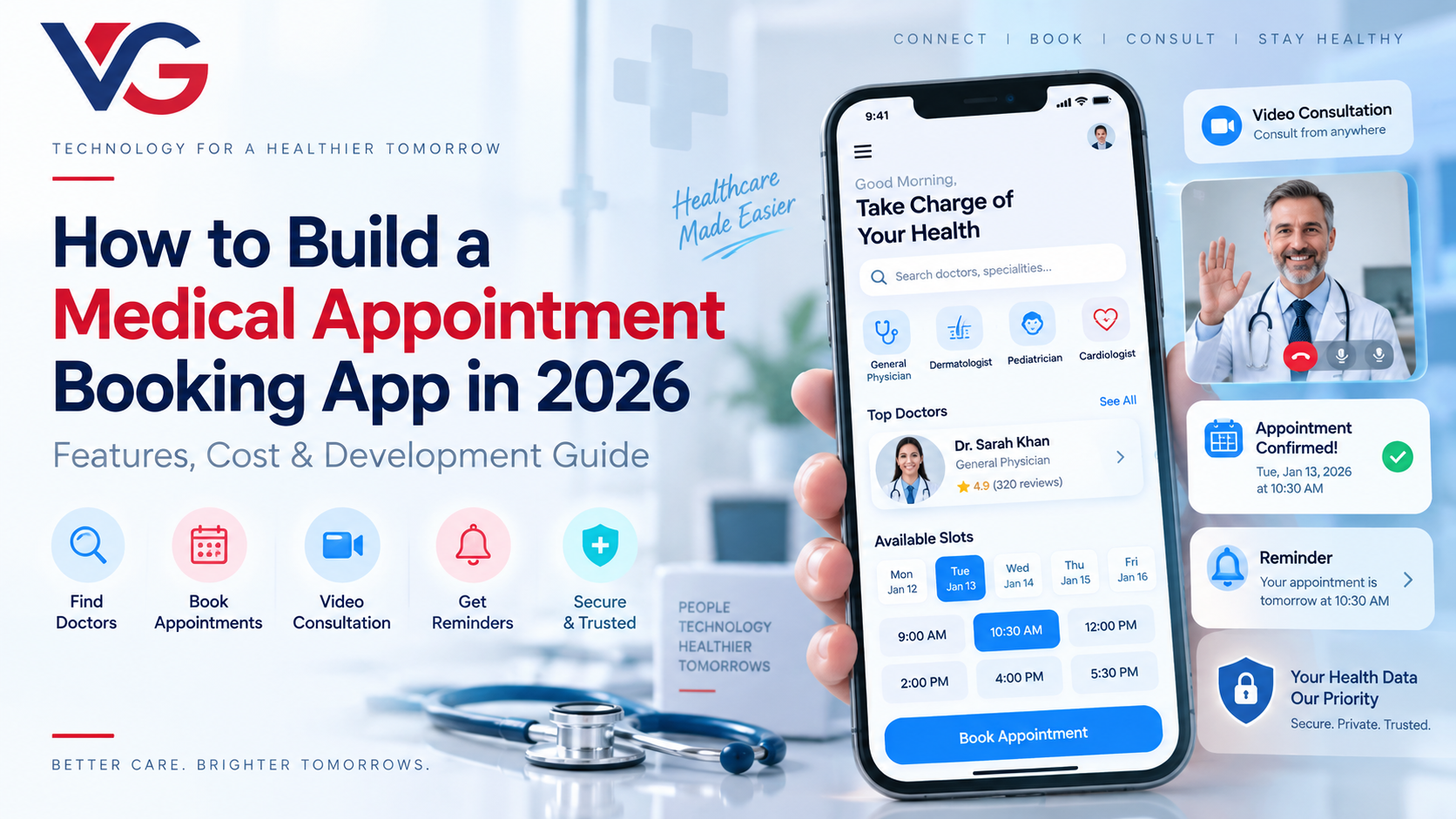
How to Build a Medical Appointment Booking App in 2026: Features, Cost & Development Guide
Healthcare is becoming increasingly digital, and patients now expect convenient ways to find doctors, check availability, schedule appointments, receive reminders, and manage their healthcare interactions online.
A medical appointment booking app can connect patients with doctors, clinics, hospitals, and other healthcare providers through a centralized digital platform. Depending on the business model, the application can support doctor discovery, appointment scheduling, online consultations, payments, medical records, prescriptions, notifications, and clinic management.
For healthcare businesses and technology companies, building an appointment booking platform can improve scheduling efficiency while giving patients a more convenient way to interact with healthcare providers.
In this guide, we explain how to build a medical appointment booking app in 2026, including essential features, patient and doctor functionality, admin capabilities, technology stack, development process, estimated cost, timeline, challenges, and scalability considerations.
What Is a Medical Appointment Booking App?
A medical appointment booking app is a mobile or web application that allows patients to search for healthcare providers and schedule appointments online.
Depending on the platform, users may be able to search for:
General physicians
Specialists
Dentists
Dermatologists
Pediatricians
Physiotherapists
Psychologists
Clinics
Hospitals
Diagnostic centers
A complete healthcare appointment platform may include:
Patient Mobile App
Doctor App or Portal
Clinic/Hospital Management Panel
Admin Dashboard
Backend and API Infrastructure
The exact architecture depends on whether the product is intended for a single clinic, a hospital network, or a multi-provider marketplace.
How Does a Medical Appointment Booking App Work?
The typical appointment workflow is:
A patient creates an account.
The patient selects a location or healthcare category.
Doctors or clinics are displayed.
The patient searches and filters providers.
The patient opens a doctor profile.
Available dates and time slots are displayed.
The patient selects an appointment.
The patient provides the required information.
Payment is completed if required.
The appointment is confirmed.
The doctor and patient receive notifications.
The appointment takes place.
The appointment status is updated.
The patient can receive follow-up information where supported.
For online consultations, the workflow can additionally include video consultation, chat, digital prescriptions, and related healthcare functionality.
Key Features of a Medical Appointment Booking App
1. Patient Registration and Login
Patients should be able to register securely using methods such as:
Email
Phone number
OTP
Password
Social authentication where appropriate
The patient profile can contain:
Basic personal information
Saved addresses
Appointment history
Favorite doctors
Upcoming appointments
Notifications
Payment history
Healthcare-related information where appropriate and legally permitted
Healthcare applications should collect only the information necessary for their intended functionality.
2. Doctor Search and Discovery
Patients should be able to find healthcare providers based on their requirements.
Search options can include:
Doctor name
Specialty
Clinic
Hospital
Location
Availability
Consultation type
For larger platforms, an optimized search system can make it easier to discover relevant providers.
3. Location-Based Search
Location functionality can help patients find nearby doctors and clinics.
Users can search based on:
Current location
City
Area
Postal code
Selected location
Map functionality can display clinic locations and provide directions where appropriate.
4. Filters and Sorting
Filters help patients narrow down healthcare providers.
Possible filters include:
Medical specialty
Location
Consultation type
Available date
Available time
Consultation fee
Experience
Language
Clinic or hospital
Sorting options can include availability, distance, or other relevant criteria defined by the platform.
5. Doctor Profile
A detailed doctor profile helps patients understand the provider before booking.
It can include:
Doctor name
Specialty
Qualifications
Experience
Languages
Clinic information
Consultation fee
Available consultation types
Working hours
Available appointment slots
Reviews and ratings
Professional profile information
All professional information should be managed and verified according to the platform's policies and applicable requirements.
6. Real-Time Appointment Availability
Real-time scheduling is one of the most important components of a medical booking application.
Doctors or clinics should be able to define:
Working hours
Appointment duration
Break periods
Holidays
Available dates
Consultation types
Appointment capacity
The system should prevent double-booking and keep availability synchronized across relevant platforms.
7. Appointment Booking
Patients should be able to select a convenient date and time and confirm an appointment.
The booking process can include:
Doctor selection
Consultation type
Date
Time slot
Patient details
Reason for visit where appropriate
Payment
Confirmation
The platform should clearly communicate appointment status after booking.
8. Appointment Management
Patients should be able to manage their appointments from one place.
Features can include:
Upcoming appointments
Completed appointments
Cancelled appointments
Rescheduling
Appointment details
Doctor information
Clinic information
Payment information
Cancellation and rescheduling rules should be configurable by the healthcare provider or platform.
9. Online Consultation
If the platform supports telemedicine, patients and doctors can conduct consultations online.
Possible functionality includes:
Video consultation
Audio consultation
Secure chat
Appointment-based consultation rooms
File sharing where appropriate
Digital prescriptions
Consultation notes
Telemedicine functionality requires careful consideration of privacy, security, professional requirements, and applicable healthcare regulations.
10. Online Payments
If patients pay through the platform, payment integration can support suitable payment methods for the target market.
The system may handle:
Consultation payments
Payment confirmation
Failed transactions
Refunds
Receipts
Transaction history
Healthcare businesses should also consider applicable tax, billing, and payment requirements.
11. Appointment Reminders
Automated reminders can reduce missed appointments.
Notifications can be sent through:
Push notifications
Email
SMS
Other supported messaging channels
Examples include:
Appointment confirmation
Upcoming appointment reminder
Rescheduled appointment
Cancellation notification
Doctor availability notification
Payment confirmation
12. Reviews and Ratings
After an appointment, patients may be allowed to provide feedback.
Possible functionality includes:
Star ratings
Written reviews
Service feedback
Clinic feedback
The platform should have moderation and privacy controls appropriate for healthcare-related reviews.
13. Patient Appointment History
Patients can view previous appointments from their account.
Information can include:
Doctor
Clinic
Appointment date
Consultation type
Status
Payment information
Follow-up details where supported
Any healthcare information stored by the platform should be protected using appropriate security and privacy controls.
Features for Doctors
A medical appointment application should provide doctors with tools for managing their schedules and appointments.
Doctor Profile Management
Doctors can manage:
Professional information
Qualifications
Specialties
Clinic locations
Consultation fees
Consultation types
Availability
Schedule Management
Doctors can configure:
Working hours
Appointment duration
Breaks
Holidays
Leave
Available slots
Appointment Management
Doctors can view:
Upcoming appointments
Completed appointments
Cancelled appointments
Patient appointment details
Notifications
Doctors can receive notifications for:
New bookings
Cancellations
Rescheduling
Upcoming appointments
Patient messages
Clinic and Hospital Management Features
If the platform supports multiple clinics or hospitals, organizations can have their own management portal.
Features may include:
Multiple doctors
Multiple departments
Doctor schedules
Appointment management
Branch management
Staff accounts
Working hours
Patient appointment records
Reports
Billing information
This can be particularly useful for healthcare organizations operating multiple locations.
Admin Dashboard Features
The admin dashboard provides centralized control over the platform.
Administrators can manage:
Patients
Doctors
Clinics
Hospitals
Specialties
Appointments
Payments
Reviews
Notifications
Locations
Reports
User roles
Platform settings
The dashboard can also provide analytics related to appointment volume, provider activity, cancellations, revenue, and platform usage.
Advanced Features for a Medical Appointment Booking App
Once the core booking system is established, businesses can introduce advanced functionality.
AI-Powered Doctor Discovery
AI can help users discover relevant providers based on information they provide, while avoiding unsupported medical diagnosis or treatment recommendations.
AI Appointment Assistant
An AI assistant can help users:
Find available appointment slots
Understand booking procedures
Reschedule appointments
Answer general platform questions
Send appointment reminders
Healthcare-specific safeguards should be applied to prevent the assistant from presenting unverified medical information as professional advice.
Telemedicine
Online consultations can extend the platform beyond in-person appointments.
Digital Prescriptions
Where legally and operationally appropriate, doctors can issue digital prescriptions through the platform.
Electronic Health Records
More advanced healthcare platforms may integrate patient records, subject to applicable regulations, interoperability requirements, and appropriate authorization.
Multi-Location Support
Healthcare organizations can manage multiple clinics and branches through a centralized system.
Recurring Appointments
Patients can schedule recurring appointments for ongoing care where supported.
Waitlist Management
If appointments are unavailable, patients can join a waitlist and receive notifications when suitable slots become available.
How to Build a Medical Appointment Booking App
1. Define the Healthcare Business Model
First, determine what type of platform you are building.
Possible models include:
Single-clinic booking app
Hospital appointment system
Doctor marketplace
Multi-clinic platform
Specialist booking platform
Telemedicine platform
Healthcare management system
The business model determines the required functionality and architecture.
2. Identify Regulatory and Privacy Requirements
Healthcare applications can handle sensitive information, so privacy and security requirements should be considered from the beginning.
Depending on the target market and functionality, requirements may involve regulations and frameworks such as:
HIPAA in applicable U.S. healthcare contexts
GDPR and UK GDPR where applicable
Local healthcare and privacy regulations
Data retention requirements
Consent requirements
Healthcare interoperability standards
The exact requirements depend on the country, business model, data being processed, and services offered. Legal and compliance professionals should be consulted for regulatory interpretation.
3. Plan the MVP
A basic appointment booking MVP can include:
Patient registration
Doctor profiles
Search and filters
Availability management
Appointment booking
Appointment management
Notifications
Payment integration
Doctor portal
Admin dashboard
Additional healthcare functionality can be introduced after validating the core product.
4. Design the UI/UX
Important patient screens can include:
Login
Home
Search
Specialty selection
Doctor listing
Doctor profile
Available slots
Appointment booking
Checkout
Appointment confirmation
Appointment history
Profile
Doctor and administrator interfaces should be designed around their specific workflows.
The design should prioritize clarity and accessibility because users may interact with healthcare applications under stressful circumstances.
5. Choose the Technology Stack
A possible technology stack includes:
Mobile Development
Flutter
React Native
Native Android
Native iOS
Web Applications
React
Angular
Next.js
Backend
Node.js
ASP.NET Core
Java / Spring Boot
Database
PostgreSQL
MySQL
SQL Server
Cloud Infrastructure
AWS
Microsoft Azure
Docker
CI/CD
Communication
Push notifications
Email
SMS
Secure video infrastructure where required
The technology stack should be selected according to the platform's functionality, security requirements, expected traffic, integrations, and regulatory obligations.
6. Develop the Backend and APIs
The backend manages the core scheduling and business logic.
It can handle:
Patient accounts
Doctor profiles
Provider availability
Appointment slots
Bookings
Payments
Notifications
Reviews
Clinics
Reports
User roles
A properly designed API architecture allows mobile applications, doctor portals, clinic systems, and admin dashboards to communicate with the backend.
7. Build the Appointment Scheduling Engine
The scheduling engine should be designed carefully to prevent booking conflicts.
It needs to consider:
Provider working hours
Appointment duration
Existing bookings
Breaks
Holidays
Cancellations
Rescheduling
Time zones
Different consultation types
Reliable scheduling is one of the most important technical components of an appointment booking platform.
8. Integrate Payment Services
If the platform charges patients online, integrate an appropriate payment provider.
The payment workflow should account for:
Payment initiation
Payment confirmation
Failed payments
Refunds
Cancellations
Receipts
Transaction records
Payment information should be handled using appropriate security practices and provider-supported mechanisms.
9. Implement Notifications
Automated notifications should keep both patients and healthcare providers informed.
The notification system can be connected to appointment events such as:
Booked → Confirmed → Reminder → Completed → Follow-Up
The exact workflow can be customized according to the healthcare provider's requirements.
10. Test the Application
Healthcare applications require comprehensive testing.
Important areas include:
Functional testing
Appointment scheduling
Double-booking prevention
API testing
Payment testing
Security testing
Access-control testing
Notification testing
Performance testing
Mobile compatibility
Usability testing
Particular attention should be given to authorization and data access so users can access only information they are permitted to see.
11. Deploy and Monitor
Before launch, configure:
Production infrastructure
Database backups
Monitoring
Error tracking
Security controls
Access management
Notification services
Payment services
Continuous monitoring helps identify performance issues and operational problems after launch.
12. Scale the Platform
As the number of patients and providers increases, the platform may require:
Database optimization
Caching
Load balancing
Horizontal scaling
Background processing
CDN integration
API optimization
Cloud infrastructure improvements
A scalable architecture can make it easier to expand from one clinic to a larger healthcare network.
How Much Does It Cost to Build a Medical Appointment Booking App in 2026?
The medical appointment booking app development cost depends on the number of platforms, features, integrations, security requirements, design complexity, and healthcare functionality.
As a broad planning estimate:
Platform Type | Estimated Development Cost |
|---|---|
Basic Appointment Booking MVP | $15,000 – $30,000 |
Multi-Doctor / Multi-Clinic Platform | $30,000 – $70,000 |
Advanced Healthcare & Telemedicine Platform | $70,000 – $150,000+ |
These are general planning ranges rather than fixed quotations.
The final cost can increase when the application includes:
Video consultations
Electronic health records
Digital prescriptions
Advanced healthcare integrations
AI functionality
Multiple healthcare organizations
Complex payment workflows
Insurance integrations
Healthcare interoperability
Advanced security and compliance requirements
How Long Does It Take to Build a Medical Appointment Booking App?
The development timeline depends on the scope of the application.
A basic appointment booking MVP may take approximately 3–5 months, while a larger healthcare platform with telemedicine and advanced integrations can require 6–12 months or more.
The process generally includes:
Business analysis
Compliance planning
UI/UX design
Mobile development
Web development
Backend development
Scheduling engine
Payment integration
Testing
Security validation
Deployment
Additional integrations and regulatory requirements can significantly affect the timeline.
Common Challenges in Medical Appointment App Development
Data Privacy and Security
Healthcare platforms may process sensitive personal and healthcare information. Strong access controls, encryption, secure authentication, logging, and appropriate data-management practices are essential.
Appointment Conflicts
The scheduling system must prevent two patients from booking the same appointment slot.
Provider Availability
Doctors may have different schedules, locations, appointment durations, holidays, and consultation types.
Regulatory Compliance
Healthcare software may be subject to different legal and regulatory requirements depending on the target market and functionality.
Payment and Refunds
Healthcare appointment cancellations and refunds require reliable transaction workflows.
Telemedicine
Video consultations require reliable communication infrastructure and appropriate privacy and security controls.
Scalability
Large healthcare platforms may handle significant numbers of simultaneous searches, bookings, notifications, and provider updates.
How to Make Your Medical Appointment Booking App Stand Out
A healthcare platform can differentiate itself by focusing on specific patient and provider needs.
Potential features include:
Fast appointment discovery
Specialist-focused search
Multiple consultation options
Telemedicine
Automated reminders
Waitlists
Recurring appointments
Multi-clinic support
Personalized provider discovery
Accessibility-focused design
Multilingual support
Integrated patient communication
AI-powered administrative assistance
The focus should remain on making healthcare access and scheduling more convenient while maintaining appropriate privacy and safety controls.
Medical Appointment App Revenue Models
A healthcare booking platform can use different business models depending on its market.
Provider Subscription
Doctors or clinics can pay a recurring subscription for access to the platform.
Booking Commission
The platform can charge a fee for completed appointments, where appropriate.
Premium Provider Listings
Healthcare providers may pay for additional visibility or profile features, subject to applicable advertising and professional rules.
Software Subscription
Clinics and hospitals can subscribe to appointment-management software.
Enterprise Plans
Larger healthcare organizations can receive customized plans with additional administrative and integration features.
The appropriate model depends on the target market, healthcare regulations, provider relationships, and platform structure.
Final Thoughts
Building a medical appointment booking app in 2026 requires more than developing a calendar and booking form. A complete healthcare platform may include patient applications, doctor portals, clinic management, appointment scheduling, payments, notifications, telemedicine, administrative tools, and secure backend infrastructure.
The appointment scheduling engine is particularly important because it must accurately manage provider availability, booking conflicts, cancellations, rescheduling, and different appointment types.
Businesses can begin with a focused MVP containing doctor discovery and appointment booking, then gradually introduce features such as telemedicine, digital prescriptions, waitlists, recurring appointments, AI-powered administrative tools, and multi-clinic management.
Because healthcare software can involve sensitive data and regulatory obligations, privacy, security, authorization, and compliance requirements should be considered from the beginning of the development process.
Build Your Medical Appointment Booking App With Vaniz Group
At Vaniz Group, we help businesses transform healthcare technology ideas into scalable digital solutions.
Our capabilities include mobile app development, web application development, custom software development, API development and integration, cloud solutions, AI automation, payment gateway integration, CRM/ERP development, and healthcare software development.
If you are planning to build a medical appointment booking app, doctor appointment platform, clinic management system, telemedicine application, patient management platform, or custom healthcare solution, Vaniz Group can help with product planning, UI/UX design, development, integrations, deployment, and future scaling.
Have a healthcare app idea? Contact Vaniz Group to discuss your project and development requirements.