 Our Client Reviews


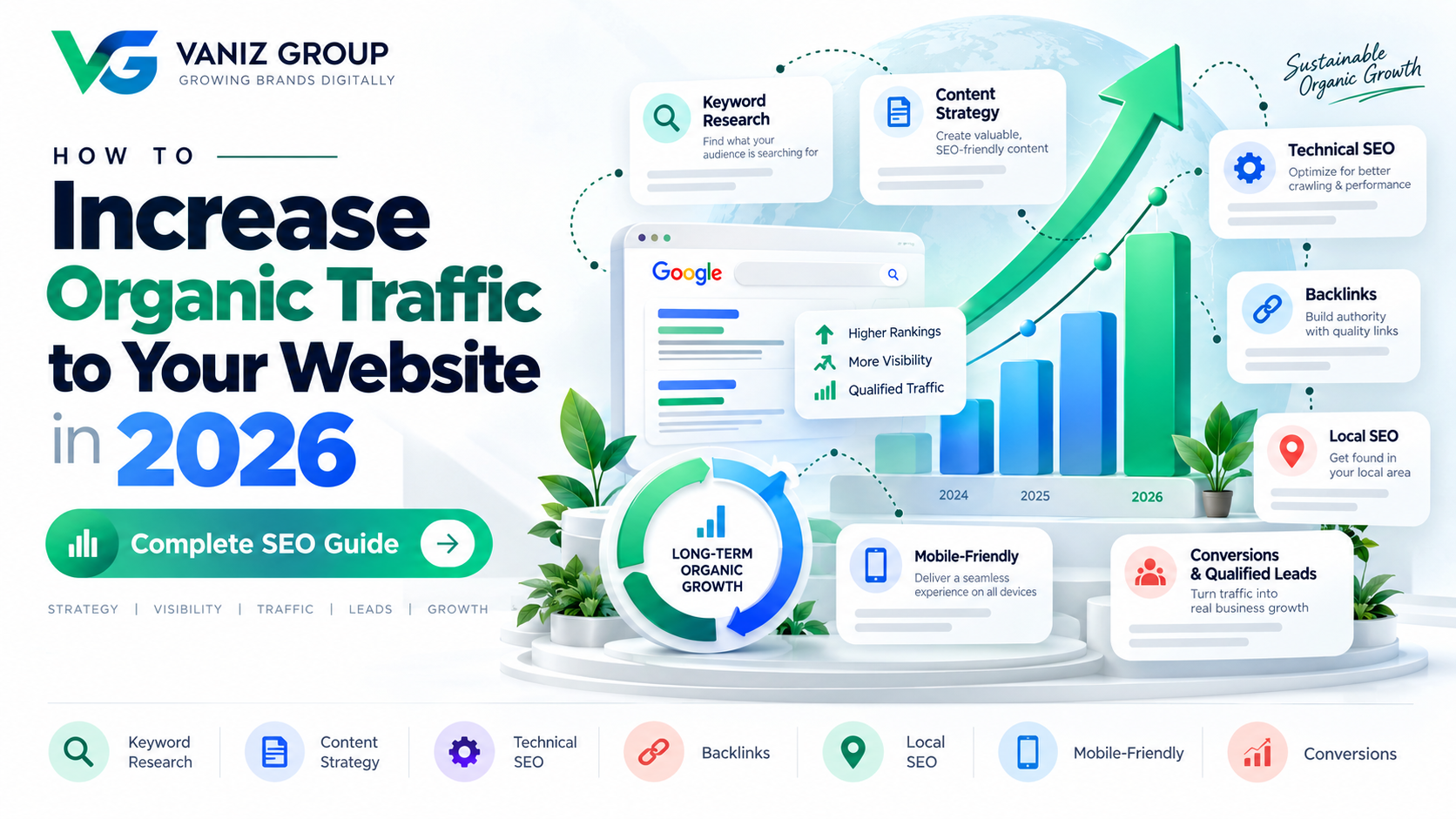
How to Increase Organic Traffic to Your Website in 2026: Complete SEO Guide
Getting visitors to your website is important, but attracting the right visitors without paying for every click can have a much bigger long-term impact on your business.
Organic traffic comes from unpaid search results and can become a consistent source of potential customers when your website has strong content, technical SEO, relevant keywords, useful landing pages, and a good user experience.
In 2026, increasing organic traffic requires more than publishing blog posts and adding keywords. Search engines increasingly evaluate the overall usefulness, relevance, accessibility, and quality of a website.
Whether you run a startup, e-commerce store, SaaS company, healthcare business, restaurant, professional service, or software company, a structured SEO strategy can help your website attract more relevant visitors.
This guide explains practical ways to increase organic traffic to your website in 2026.
What Is Organic Traffic?
Organic traffic refers to visitors who reach your website through unpaid search engine results.
For example, someone searches Google for:
"custom software development company"
and clicks a non-paid search result that leads to your website.
That visitor is considered organic traffic.
Organic traffic can come from searches related to:
Products
Services
Questions
Problems
Locations
Industries
Comparisons
Tutorials
Solutions
The objective isn't simply to increase the number of visitors. You want to attract people who are genuinely interested in what your business offers.
Why Organic Traffic Matters in 2026
Organic search can become an important long-term acquisition channel for businesses.
A strong organic presence can help you:
Increase brand visibility
Reach potential customers actively searching for solutions
Generate qualified website visitors
Build authority in your industry
Reduce dependence on paid advertising
Promote services and products
Create long-term content assets
Generate leads through search
For example, a software development company can publish useful content around mobile apps, SaaS, AI, e-commerce, healthcare software, and custom business applications.
Each useful article can create another opportunity for relevant search traffic.
How to Increase Organic Traffic to Your Website
1. Understand Your Target Audience
The first step is identifying exactly who you want to attract.
Ask:
Who are your ideal customers?
What problems do they have?
What services are they looking for?
What questions do they ask?
What solutions are they researching?
Which locations do you serve?
What industries do you specialize in?
For example, a custom software company might target:
Startups
Small businesses
Medium-sized businesses
Enterprises
Healthcare organizations
Restaurants
E-commerce companies
SaaS businesses
This information should influence your keywords, content, service pages, and website structure.
2. Perform Keyword Research
Keyword research helps you understand what potential customers search for.
Instead of targeting only broad keywords, create a mixture of search terms.
Informational Keywords
Examples:
How to build a mobile app
How to increase website traffic
What is SaaS development?
Commercial Keywords
Examples:
Best software development company
Custom e-commerce development
Healthcare app development services
Transactional Keywords
Examples:
Hire app developers
Custom software development company
E-commerce development services
Local Keywords
Examples:
Web development company in London
App development company in New York
Software development company in Dubai
A good keyword strategy considers relevance and search intent, not just search volume.
3. Focus on Search Intent
Understanding search intent is one of the most important parts of modern SEO.
Consider the search:
"how to build a food delivery app"
The person may want information about:
Features
Technology
Development process
Cost
Timeline
Monetization
Challenges
If your article only explains what a food delivery app is, it may not fully satisfy the searcher's needs.
Before writing an article, determine what the searcher is actually trying to accomplish.
Then create content that answers that need comprehensively.
4. Create High-Quality Service Pages
Your website shouldn't depend entirely on blog traffic.
Create dedicated pages for your most important services.
For example:
Web Development
Mobile App Development
Custom Software Development
E-Commerce Development
AI Development
SaaS Development
API Development
Cloud Solutions
Each page should explain:
What you offer
Who the service is for
Problems you solve
Features and capabilities
Technologies
Development process
Benefits
FAQs
Relevant examples
How customers can contact you
These pages can target valuable commercial searches.
5. Publish Helpful Blog Content
Blog content can expand your organic search footprint.
Instead of publishing random articles, build content around topics connected to your services.
For example, a software development company could publish:
How to Build an AI-Powered Application
How to Build a Food Delivery App
How to Build a Healthcare Appointment Platform
How to Build an E-Commerce Website
How to Build a Dating Website
How to Build a SaaS Application
How to Turn a Website Into a Mobile App
These articles can attract people who are researching a project before contacting a development company.
6. Build Topic Clusters
A topic cluster connects related content around a central subject.
For example:
Pillar Page
Mobile App Development Services
Supporting Articles
How to Build a Mobile App
How Much Does It Cost to Build a Mobile App?
How to Build a Food Delivery App
How to Build a Healthcare App
How to Build a Dating App
How to Turn a Website Into a Mobile App
Flutter vs React Native
Link relevant articles back to the main service page and to one another where useful.
This creates a more organized website structure and helps visitors discover related information.
7. Improve Your Internal Linking
Internal links connect pages within your own website.
For example, an article about e-commerce development could link to:
E-Commerce Development
Web Development
Custom Software Development
Payment Gateway Integration
API Development
Internal linking can help:
Visitors discover related content
Search engines discover pages
Establish relationships between topics
Distribute internal authority across relevant pages
Improve website navigation
Avoid adding links simply for the sake of adding links. They should be relevant and useful.
8. Optimize Your Page Titles
Page titles help users and search engines understand what a page is about.
Instead of:
Services
Use something more descriptive:
Custom Software Development Services | Vaniz Group
For blog content:
How to Increase Organic Traffic to Your Website in 2026
A good title should clearly communicate the subject of the page while naturally incorporating the primary topic where appropriate.
9. Write Better Meta Descriptions
Meta descriptions can help users understand what they will find when they encounter your page in search results.
For example:
Learn how to increase organic traffic in 2026 using keyword research, technical SEO, content marketing, internal linking, local SEO and website optimization.
Write descriptions that accurately represent the page rather than filling them with keywords.
10. Improve Your Website's Technical SEO
Technical SEO provides the foundation for organic growth.
Check:
Crawlability
Indexability
XML sitemap
Robots.txt
Canonical URLs
HTTPS
Redirects
Broken links
Server errors
Mobile usability
Page performance
Structured data
A technically accessible website makes it easier for search engines to crawl and process your content.
11. Improve Website Speed
Slow websites can create a poor user experience.
Consider improving:
Image compression
JavaScript loading
CSS delivery
Server response time
Caching
Database performance
CDN configuration
Unnecessary third-party scripts
Use appropriate performance testing tools to identify specific bottlenecks instead of optimizing blindly.
12. Optimize Your Website for Mobile
Your website should work properly across:
Smartphones
Tablets
Laptops
Desktop computers
Check:
Navigation
Buttons
Forms
Font sizes
Images
Page layouts
Interactive elements
Content visibility
Make sure important information isn't removed from the mobile version of your website.
13. Create Content for Long-Tail Keywords
Long-tail keywords are more specific search queries.
For example:
Broad:
App development
More specific:
How much does it cost to build a food delivery app?
Another example:
Broad:
E-commerce development
More specific:
How to build a fashion e-commerce website in 2026
Specific queries can help you attract visitors with a clearer intent.
14. Create Industry-Specific Content
One effective way to expand organic traffic is to create content for the industries you serve.
For a software development company, examples include:
Healthcare
Healthcare app development
Doctor appointment software
Telemedicine platforms
Healthcare management systems
Restaurants
Restaurant management software
Restaurant ordering systems
Restaurant booking platforms
Food delivery applications
E-Commerce
E-commerce websites
Fashion shopping apps
Multi-vendor marketplaces
Online store development
Real Estate
Real estate apps
Property management systems
Property listing platforms
Real estate marketplaces
This creates opportunities to rank for industry-specific searches while demonstrating expertise to potential customers.
15. Optimize Existing Content
You don't always need to publish a new article to increase traffic.
Review existing content and identify pages that already receive:
Impressions
Clicks
Search traffic
Rankings for related keywords
Then improve them where appropriate.
You might:
Add missing information
Improve headings
Add relevant internal links
Update outdated sections
Improve examples
Add FAQs
Improve the introduction
Clarify search intent
Add relevant service links
Don't change content simply to make it longer. The goal is to make it more useful.
16. Build Relevant Backlinks
Backlinks are links from other websites to your website.
Relevant links from reputable websites can contribute to your site's authority and discoverability.
Potential approaches include:
Industry publications
Relevant business directories
Partnerships
Expert interviews
Digital PR
Original research
Industry reports
Useful resources
Case studies
Avoid focusing on large quantities of low-quality links.
A smaller number of genuinely relevant references can be more useful than large volumes of unrelated links.
17. Strengthen Your Local SEO
If you serve customers in specific locations, local SEO can help you reach people searching for businesses nearby or in a target market.
Important areas include:
Business information
Location pages
Business profiles
Reviews
Local directories
Consistent contact information
Location-specific content
For example, a development company targeting London could create useful content around software development services for London businesses rather than simply creating a page that repeats the word "London."
18. Use Google Search Console
Google Search Console is an important tool for monitoring organic search performance.
You can use it to understand:
Search queries
Impressions
Clicks
Search positions
Indexed pages
Pages that aren't indexed
Technical issues
Search performance trends
Look for pages that receive high impressions but relatively few clicks.
These pages may provide opportunities to improve:
Titles
Descriptions
Search intent alignment
Content
Internal linking
19. Optimize Images
Images can improve user experience while also contributing to search visibility when handled correctly.
Use:
Descriptive filenames
Appropriate dimensions
Compressed images
Modern formats such as WebP where suitable
Accurate alt text
For example:
Poor filename:
IMG_2045.jpg
Better filename:
custom-software-development-team.webp
Alt text should describe the image accurately rather than being used as a place to insert keywords.
20. Optimize for AI-Powered Search
Search experiences are evolving, and users may increasingly encounter AI-generated answers and AI-assisted search interfaces.
To make your content easier to understand:
Answer questions directly
Use descriptive headings
Explain concepts clearly
Structure information logically
Include useful examples
Demonstrate genuine expertise
Keep information accurate and updated
Avoid unnecessary filler
Don't create content exclusively for AI systems. Write for people first and make the information clear enough for search systems to understand.
21. Use Structured Data Where Appropriate
Structured data can help search engines understand certain types of content.
Depending on your website, relevant structured data may include:
Organization
Local business
Product
Article
Breadcrumb
Event
Use structured data accurately and only where it reflects information actually present on the page.
Structured data doesn't guarantee enhanced search results, but it can provide useful context to search engines.
22. Create Strong Calls to Action
Organic traffic becomes more valuable when visitors have a clear next step.
Depending on your business, CTAs could include:
Request a Quote
Book a Consultation
Contact Our Team
Request a Demo
Get Started
Discuss Your Project
For example, an article about building a healthcare platform could end with:
Planning to Build a Healthcare Platform?
Vaniz Group can help you design and develop custom healthcare applications, appointment platforms, APIs, dashboards, and business systems.
The CTA should match the user's intent and the topic of the page.
23. Build Trust With Your Website Visitors
SEO brings visitors to your website, but trust can determine whether they stay and contact you.
Show evidence of your capabilities through:
Portfolio projects
Case studies
Client testimonials
Technology expertise
Industry experience
Company information
Clear contact details
Detailed service pages
Useful technical content
For a development company, showing actual projects and capabilities can make service pages more convincing.
24. Keep Your Content Updated
SEO content shouldn't be considered finished forever.
Review important articles periodically.
Update:
Technology references
Dates
Features
Examples
Pricing estimates
Screenshots
Internal links
Outdated recommendations
For example, an article titled:
How to Build an AI-Powered Application in 2026
should be reviewed when significant developments change the technology or development process.
25. Track Organic Traffic and Conversions
Traffic is useful, but traffic alone isn't the ultimate business goal.
Track:
Organic sessions
Search impressions
Search clicks
Search queries
Landing pages
Rankings
Engagement
Contact form submissions
Calls
Demo requests
Qualified leads
A page receiving 500 highly relevant visitors can potentially be more valuable than a page receiving thousands of visitors with little business relevance.
The objective should be qualified organic traffic, not traffic at any cost.
Common Mistakes That Can Limit Organic Traffic
Keyword Stuffing
Repeating keywords unnaturally can make content difficult to read.
Publishing Low-Quality Content
Publishing large quantities of shallow content doesn't automatically produce organic growth.
Ignoring Search Intent
A page can target the right keyword but still fail to satisfy what the user wants.
Creating Duplicate Pages
Too many similar pages can make your website difficult to manage and understand.
Ignoring Technical SEO
Crawlability and indexing problems can prevent valuable content from performing.
Buying Low-Quality Links
Unrelated or manipulative link-building tactics can create risks rather than sustainable growth.
Focusing Only on Rankings
Ranking improvements are useful, but business outcomes such as qualified leads and sales opportunities matter too.
How Long Does It Take to Increase Organic Traffic?
There is no universal timeline for SEO results.
Organic traffic growth depends on:
Website age
Existing authority
Competition
Industry
Content quality
Technical SEO
Search demand
Backlink profile
Publishing consistency
Target market
New websites generally need time to establish their presence, while established websites with existing authority may have different growth patterns.
SEO should therefore be approached as a long-term strategy rather than a guaranteed quick traffic solution.
A Simple 2026 Organic Traffic Strategy
If you're starting from scratch, use this framework:
Month 1: Build the Foundation
Set up Google Search Console
Submit your sitemap
Fix technical SEO issues
Research keywords
Define target audiences
Create important service pages
Month 2: Build Content
Publish useful industry articles
Create supporting blog content
Improve internal linking
Optimize titles and descriptions
Create relevant landing pages
Month 3 and Beyond: Improve and Expand
Review Search Console data
Update existing content
Build relevant backlinks
Create new topic clusters
Improve pages with high impressions
Expand into industry-specific keywords
Monitor conversions
The exact timeline and priorities should depend on your website and market rather than following a fixed schedule blindly.
How Vaniz Group Can Help With Your Website Growth
Increasing organic traffic requires more than publishing blog posts. Your website needs a strong combination of technical development, website structure, content, user experience, performance, and ongoing optimization.
Vaniz Group provides technology solutions including:
Web Development
Web App Development
Custom Software Development
E-Commerce Development
Mobile App Development
API Development and Integration
AI Automation
Cloud Solutions
Custom Business Applications
If your business website isn't attracting enough relevant visitors, the first step is understanding where the problem exists — whether it is technical SEO, content, website architecture, search intent, performance, or conversion experience.
Planning to increase organic traffic to your website in 2026? Contact Vaniz Group to discuss your website development and digital growth requirements.
Final Thoughts
Increasing organic traffic in 2026 requires a complete approach rather than a single SEO tactic.
Start with your audience and search intent. Research relevant keywords, create useful content, build dedicated service pages, improve technical SEO, strengthen internal links, optimize performance, build relevant authority, and continuously analyze your results.
Most importantly, don't chase traffic simply because a keyword has a large search volume.
Focus on attracting the right people, answering their questions, solving their problems, and giving them a clear path toward becoming a customer.
When technical SEO, content strategy, website development, user experience, and conversion optimization work together, organic search can become a valuable long-term source of business growth.