 Our Client Reviews


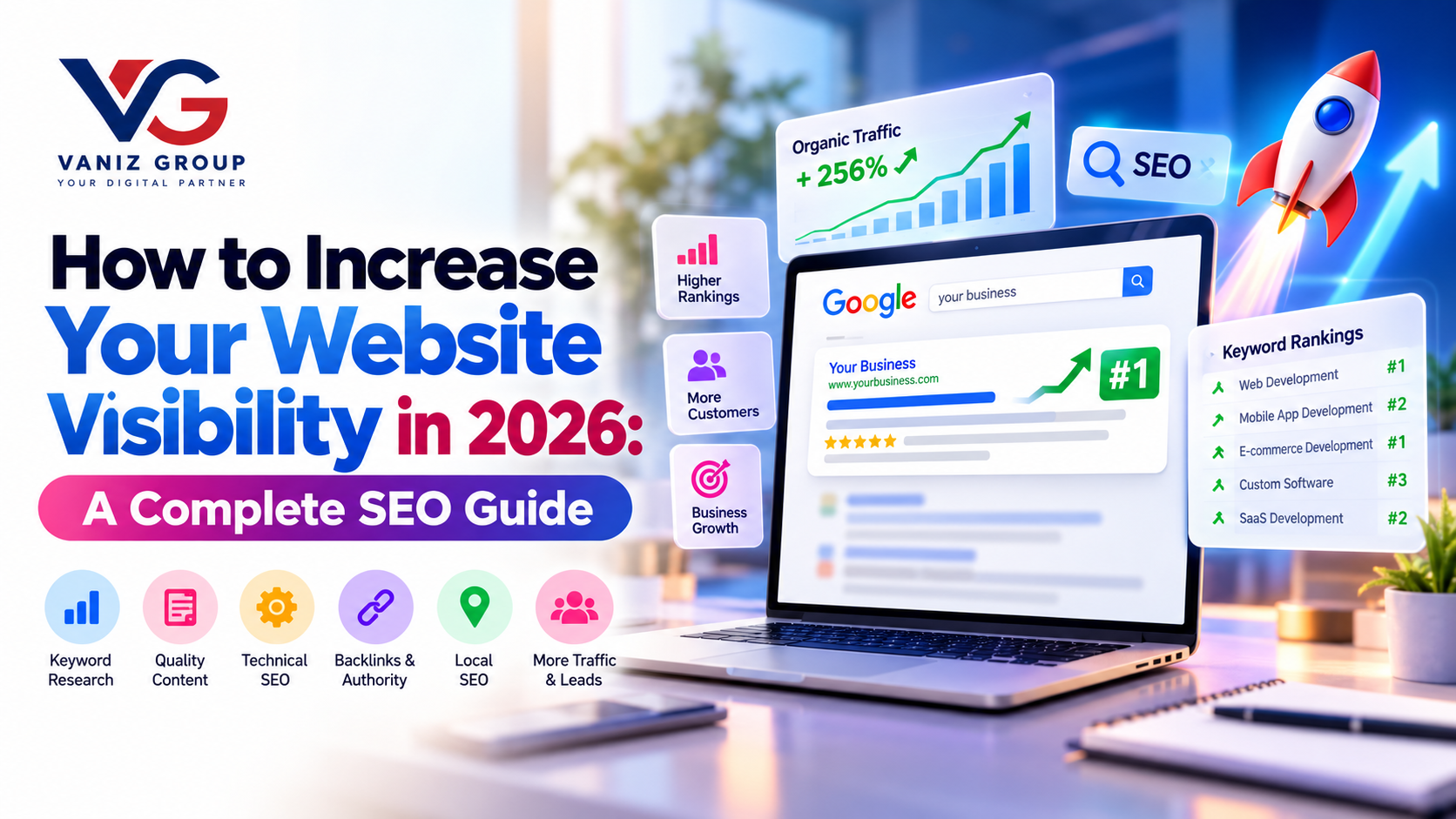
In 2026, having a website is not enough to attract customers. Your website needs to be visible when potential customers search for your products, services, solutions, or industry-related information.
Whether you run a startup, e-commerce store, healthcare business, restaurant, SaaS company, professional service, or local business, website visibility plays an important role in generating organic traffic and qualified leads.
Search engine optimization (SEO) can help improve how easily search engines discover, understand, and rank your website. But modern SEO involves much more than simply adding keywords to pages. Technical performance, useful content, search intent, user experience, local SEO, authority, and visibility across newer search experiences all need to work together.
In this guide, we explain how to increase your website visibility in 2026 and build a practical SEO strategy for long-term growth.
What Is Website Visibility?
Website visibility refers to how easily people can find your website through search engines and other online channels.
For example, if someone searches for:
Custom software development company
Healthcare app development
Restaurant management software
E-commerce website development
Mobile app development company
you want your relevant pages to appear when the search matches what your business offers.
Website visibility can be influenced by several factors, including:
Search engine rankings
Keyword relevance
Website content
Technical SEO
Website speed
Mobile experience
Backlinks and authority
Local SEO
Search intent
User experience
Structured data
Brand presence
Content quality
The goal is not simply to get more visitors. The goal is to attract relevant visitors who are more likely to become customers.
Why Website Visibility Matters in 2026
Customers increasingly research businesses online before making purchasing decisions.
A potential customer may discover your company through:
Google searches
Local search results
Industry-specific searches
Blog articles
Product pages
Service pages
Online directories
Social media
AI-powered search experiences
Reviews and business listings
A strong website visibility strategy helps create multiple opportunities for potential customers to discover your business.
For example, a software development company could create separate optimized pages for:
Web development
Mobile app development
Custom software development
SaaS development
AI development
E-commerce development
Healthcare software
Restaurant software
Each page can target a different search intent and attract a different type of potential customer.
How to Increase Your Website Visibility in 2026
1. Define Your Target Audience
Before working on SEO, understand who you want to attract.
Your target audience determines:
What keywords you target
What content you create
What services you promote
What questions you answer
What landing pages you need
For example, a company providing software development services may target:
Startups
Small businesses
Medium-sized businesses
Enterprise companies
Restaurant businesses
Healthcare organizations
E-commerce companies
Instead of trying to rank for every possible keyword, create content around the problems and services that matter to your ideal customers.
2. Perform Keyword Research
Keyword research is one of the foundations of SEO.
The objective is to understand what your potential customers search for and why they search for it.
Consider different types of keywords:
Informational Keywords
Users are looking for information.
Examples:
How to build a mobile app
How to improve website visibility
What is SaaS development?
Commercial Keywords
Users are researching solutions or providers.
Examples:
Best mobile app development company
SaaS development services
Custom e-commerce development
Transactional Keywords
Users are closer to taking action.
Examples:
Hire app developer
Custom software development company
E-commerce website development services
Local Keywords
Users are searching for services in a specific location.
Examples:
Software development company in London
Web development company in New York
App developers in Dubai
A strong SEO strategy usually combines multiple keyword types instead of focusing only on high-volume keywords.
3. Create Dedicated Service Pages
One common SEO mistake is putting every service on a single page.
If your business offers multiple services, create dedicated pages for important services.
For example:
Web Development
Mobile App Development
Custom Software Development
E-Commerce Development
AI Development
SaaS Development
API Development
Cloud Solutions
Each page should clearly explain:
What the service is
Who it is for
Problems it solves
Features or capabilities
Development process
Technology options
Benefits
Frequently asked questions
Call to action
This gives search engines clearer context about what your business offers.
4. Create Helpful, Industry-Specific Content
Blogging can help expand the number of relevant searches your website can target.
Instead of publishing generic articles, create content around your target industries.
For example, a software company could publish:
How to Build a Healthcare Appointment Booking Platform
How to Build a Restaurant Management System
How to Build a Beauty Salon Booking Platform
How to Build a Food Delivery App
How to Build a Fashion E-Commerce App
How to Build a Real Estate Platform
How to Build an AI-Powered Application
This approach allows your website to target different industries, technologies, business models, and search intents.
5. Optimize Your Website Titles and Meta Descriptions
Every important page should have a clear and relevant title.
For example:
Poor title:
Services | Company
Better title:
Custom Software Development Services | Vaniz Group
Your meta description should explain what users can expect from the page.
For example:
Build scalable custom software solutions with Vaniz Group. Explore our software development services, technologies, integrations and development process.
Titles and descriptions should be written primarily for relevance and clarity rather than stuffing keywords.
6. Optimize Your Website Headings
Use a logical heading structure.
For example:
H1
How to Increase Your Website Visibility in 2026
H2
Why Website Visibility Matters
H2
How to Increase Website Visibility
H3
Perform Keyword Research
H3
Create Helpful Content
H3
Improve Technical SEO
Clear headings help visitors understand the page and make long-form content easier to navigate.
7. Improve Technical SEO
Technical SEO helps search engines crawl, understand, and index your website.
Important areas include:
Crawlability
Indexing
XML sitemap
Robots.txt
Canonical URLs
HTTPS
Mobile usability
Page speed
Core Web Vitals
Structured data
Broken links
Redirects
Duplicate content
URL structure
A technically strong website gives your content a better foundation for search visibility.
8. Make Your Website Mobile-Friendly
A large percentage of web activity takes place on mobile devices.
Your website should provide a consistent experience across:
Smartphones
Tablets
Laptops
Desktop computers
Check that:
Text is easy to read
Buttons are easy to tap
Navigation works correctly
Forms work on smaller screens
Images scale properly
Pages load efficiently
Important information is easy to find
Mobile usability should be considered from the beginning rather than added as an afterthought.
9. Improve Website Speed
Website performance affects user experience and can influence how effectively your pages perform in search.
You can improve performance by:
Compressing images
Using modern image formats
Minifying unnecessary resources
Reducing unused JavaScript
Using caching
Optimizing database queries
Using a CDN where appropriate
Improving server response time
Lazy-loading suitable images and resources
For businesses, performance is particularly important on landing pages where visitors are deciding whether to contact you.
10. Build a Strong Internal Linking Structure
Internal links connect related pages on your website.
For example, a blog about building a food delivery app could link to:
Mobile App Development
Custom Software Development
API Development
Payment Gateway Integration
Cloud Solutions
Similarly, an e-commerce article could link to:
E-Commerce Development
Web Development
Custom Software Development
Payment Integration
Internal linking helps visitors discover related content and helps search engines understand relationships between pages.
11. Optimize Images for SEO
Images can also contribute to website visibility and user experience.
Before publishing images:
Compress the image
Use an appropriate format such as WebP where suitable
Use descriptive filenames
Add meaningful alt text
Avoid unnecessarily large image dimensions
For example:
Poor filename:
IMG12345.jpg
Better filename:
ecommerce-website-development-2026.webp
Alt text should describe the image accurately rather than being stuffed with keywords.
12. Create Local SEO Signals
If your business serves specific cities, countries, or regions, local SEO can be valuable.
Make sure your business information is consistent across relevant online profiles and directories.
Important elements can include:
Business name
Address where applicable
Phone number
Website
Business category
Service areas
Reviews
Business profile information
You can also create location-specific pages when they genuinely provide useful information for customers.
Avoid creating dozens of nearly identical location pages simply to target city names.
13. Build High-Quality Backlinks
Backlinks are links from other websites to your website.
Relevant links from reputable websites can help strengthen your site's authority and discoverability.
Potential approaches include:
Industry publications
Business directories
Partner websites
Expert interviews
Digital PR
Guest contributions
Original research
Useful resources
Case studies
Industry reports
The focus should be on earning relevant links rather than obtaining large numbers of low-quality links.
14. Build Topic Clusters
Instead of publishing unrelated blog posts, organize content around important topics.
For example, if Mobile App Development is an important service, you could create a topic cluster:
Pillar page:
Mobile App Development Services
Supporting articles:
How to Build a Mobile App
How Much Does It Cost to Build a Mobile App?
Flutter vs React Native
How to Turn a Website Into a Mobile App
How to Build a Food Delivery App
How to Build a Healthcare App
How to Build a Dating App
How to Build a Travel Booking App
You can then connect these pages through internal links.
This creates a stronger content structure and gives users multiple ways to explore your expertise.
15. Optimize for Search Intent
Ranking for a keyword is not enough if your content doesn't satisfy what the searcher wants.
For example, someone searching:
"how to build a food delivery app"
probably wants information about:
Features
Development process
Technology
Cost
Timeline
Monetization
Challenges
If your page only contains a short definition of a food delivery app, it may not adequately address the search intent.
Before creating content, ask:
What does the person actually want to accomplish with this search?
Then structure the page around that need.
16. Add FAQs to Important Pages
Frequently asked questions can help answer common customer concerns.
For example, a software development service page could answer:
How much does custom software development cost?
How long does development take?
Can you integrate existing APIs?
Can you build mobile and web applications?
Do you provide maintenance after launch?
Can you scale an existing application?
FAQs should provide genuinely useful answers rather than being created solely to add keywords.
17. Strengthen Your E-E-A-T Signals
For competitive topics, demonstrate why visitors should trust your business.
Your website can communicate experience and expertise through:
Detailed service pages
Case studies
Portfolio examples
Client testimonials
Author information
Company information
Technical documentation
Original insights
Project results
Clear contact information
For a software development company, showing real development capabilities and completed projects can make service pages more convincing to potential clients.
18. Optimize for AI and Modern Search Experiences
Search behavior continues to evolve, including the use of AI-powered search and answer experiences.
To make your content easier to understand and reuse across search experiences:
Answer questions clearly
Use descriptive headings
Provide concise definitions
Explain concepts in context
Use structured content
Support claims with reliable sources where appropriate
Demonstrate first-hand expertise
Keep information accurate and updated
Cover topics comprehensively
Don't write content solely for search engines. Create content that is genuinely useful to people.
19. Keep Your Content Updated
Publishing an article once does not mean the SEO work is finished.
Review important content periodically.
Update:
Statistics
Technology references
Screenshots
Pricing estimates
Features
Examples
Internal links
Outdated information
Year references
For example, an article titled:
How to Build a Mobile App in 2026
should be reviewed when technologies, platforms, development practices, or other important information changes.
20. Track Your SEO Performance
SEO should be measured using actual website data.
Monitor metrics such as:
Organic clicks
Organic impressions
Search queries
Average search position
Indexed pages
Organic landing pages
Conversion rate
Leads generated
Engagement
Technical errors
More traffic is not necessarily better if it doesn't attract the right audience.
For a business website, connect SEO performance to business outcomes such as qualified inquiries, contact form submissions, calls, demo requests, and sales opportunities.
Common SEO Mistakes to Avoid
Many businesses make SEO harder than it needs to be.
Avoid:
Keyword Stuffing
Repeating the same keyword excessively can make content unnatural.
Publishing Thin Content
Short pages that provide little useful information rarely create a strong reason for users to stay.
Copying Competitor Content
Research competitors for ideas, but create original and more useful content.
Ignoring Technical SEO
Great content cannot compensate for serious technical problems.
Creating Too Many Similar Pages
Large numbers of nearly identical pages can create a poor user experience.
Buying Low-Quality Backlinks
Focus on relevance and quality rather than backlink volume.
Ignoring Conversion Optimization
Getting visitors is only one part of digital marketing. Your website should also make it easy for qualified visitors to take the next step.
How Long Does It Take to Increase Website Visibility?
SEO results vary significantly depending on factors such as:
Website age
Industry competition
Existing authority
Content quality
Technical condition
Target keywords
Geographic market
Backlink profile
Publishing consistency
A newer website may need time to establish visibility, while an established website with existing authority may see changes sooner.
SEO should therefore be treated as a long-term website growth strategy, rather than a guaranteed short-term ranking solution.
SEO Strategy for Different Industries
The right SEO strategy depends on the industry.
E-Commerce
Focus on:
Product pages
Categories
Product comparisons
Buying guides
Reviews
Commercial keywords
Healthcare
Focus on:
Service information
Location-based searches
Provider information
Trust signals
Accurate and carefully reviewed content
Restaurants
Focus on:
Local SEO
Menu pages
Location information
Reviews
Food-related searches
Online ordering and reservations
Real Estate
Focus on:
Property pages
Location searches
Neighborhood content
Market information
Property guides
SaaS Companies
Focus on:
Product pages
Use cases
Feature pages
Comparisons
Integration pages
Educational content
Software Development Companies
Focus on:
Service pages
Technology pages
Industry solutions
Case studies
Development guides
Cost-related searches
Portfolio content
How Vaniz Group Can Help Improve Your Online Presence
Improving website visibility requires more than publishing blog posts. Your website needs the right combination of design, development, technical performance, content structure, integrations, and ongoing optimization.
At Vaniz Group, we help businesses build and improve modern websites and web applications designed around their business goals.
Our capabilities include:
Website development
Web application development
Custom software development
E-commerce development
Mobile app development
API development and integration
AI automation
Cloud solutions
Custom business systems
Performance and technical improvements
If your website is not attracting enough relevant visitors or converting them into leads, a combination of technical improvements, better content architecture, industry-specific landing pages, and a consistent SEO strategy can help create a stronger foundation for growth.
Want to improve your website visibility in 2026? Contact Vaniz Group to discuss your website, SEO, and development requirements.
Final Thoughts
Increasing website visibility in 2026 requires a complete approach to SEO.
Start by understanding your audience and search intent. Build dedicated service pages, create useful industry-specific content, improve technical SEO, optimize website performance, strengthen internal linking, build relevant authority, improve local visibility where applicable, and continuously measure your results.
Most importantly, focus on creating a website that is useful to your target customers, not simply optimized around keywords.
When SEO, content, website development, user experience, and conversion strategy work together, your website can become a long-term channel for attracting relevant visitors and generating business opportunities.