 Our Client Reviews

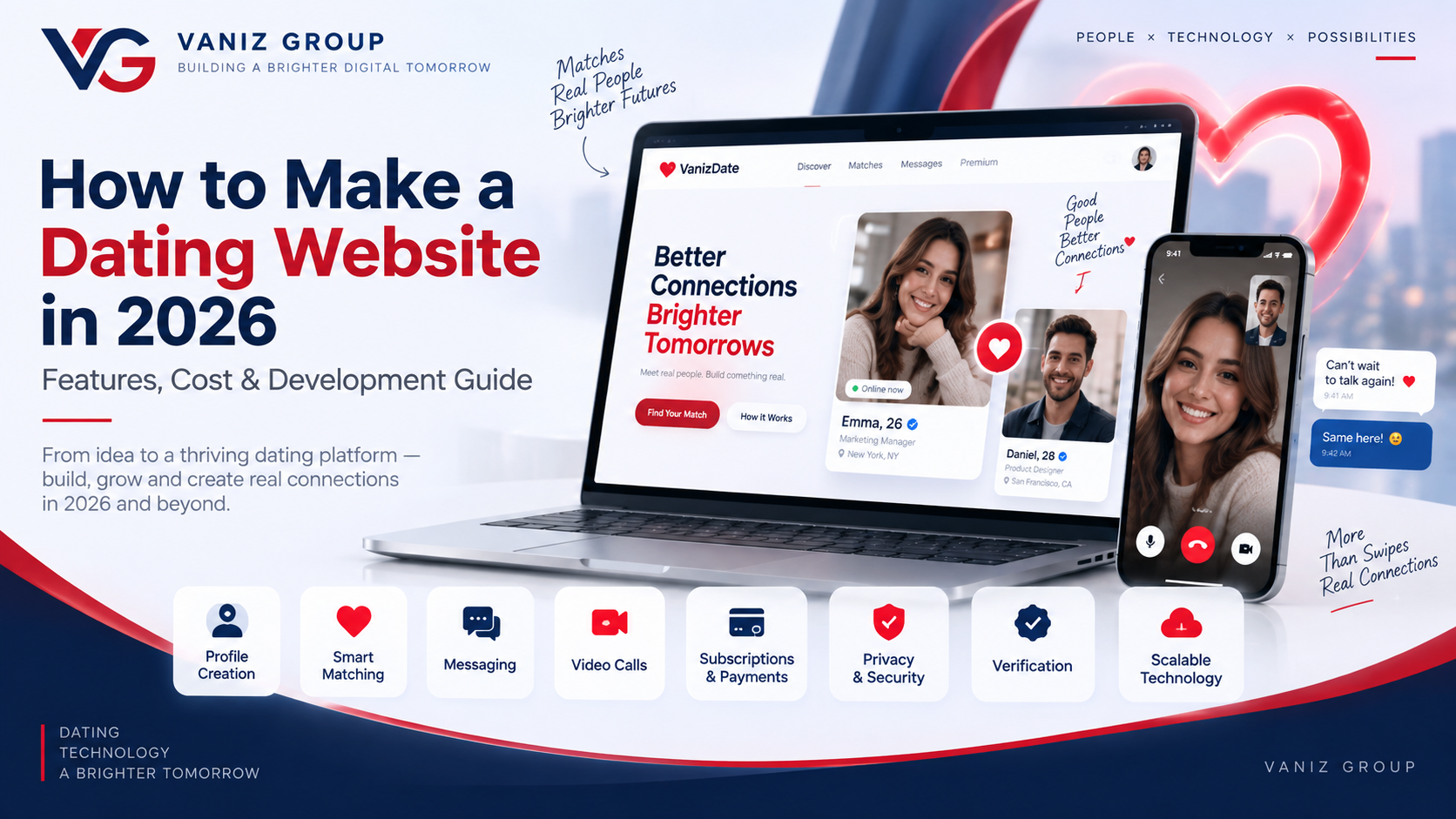
How to Make a Dating Website in 2026: Features, Cost & Development Guide
Online dating has become an important way for people to discover new connections, communicate with potential partners, and build relationships. A modern dating website can go far beyond simple user profiles and search. It can include intelligent matching, private messaging, profile verification, subscriptions, video calls, personalized recommendations, and powerful safety tools.
If you are planning to make a dating website in 2026, the first step is to decide what type of dating experience you want to create. Your platform could target a broad audience or focus on a specific community, location, interest, lifestyle, or relationship goal.
This guide explains how to make a dating website, including essential features, matching systems, technology stack, development process, estimated cost, monetization options, security considerations, and scalability.
What Is a Dating Website?
A dating website is an online platform where users create profiles, discover other users, communicate, and potentially build romantic or social connections.
A typical dating platform can include:
User registration
Dating profiles
Photos and videos
Search and discovery
Matching
Likes and interests
Private messaging
Voice and video calls
Location-based discovery
Profile verification
Notifications
Subscriptions
Payments
Reporting and blocking
Admin moderation
The exact features depend on the target audience and business model.
How Does a Dating Website Work?
A typical dating website can follow this workflow:
Registration → Profile Creation → Preferences → Discovery → Match → Messaging → Connection
Users create profiles and specify relevant preferences such as:
Age range
Location
Interests
Languages
Relationship goals
Lifestyle preferences
The platform can then use filters, matching rules, or recommendation algorithms to present potentially compatible profiles.
Once two users express mutual interest, the platform can allow them to communicate according to its privacy and safety rules.
How to Make a Dating Website
1. Define Your Dating Website Concept
Before development, clearly define the audience and purpose of the platform.
You could create:
General dating website
Local dating platform
Community-focused dating website
Professional dating platform
Interest-based dating website
Relationship-focused platform
International dating platform
Niche dating community
A focused concept can make it easier to design the right features and attract a relevant user base.
2. Research Your Target Audience
Research what your intended users actually need.
Consider:
Target countries
Target age groups
Relationship goals
Preferred communication methods
Languages
Privacy expectations
Payment preferences
Cultural considerations
Common safety concerns
This research should influence the profile structure, discovery experience, matching logic, and monetization model.
3. Plan the User Registration System
Registration should be simple while collecting enough information to create a useful dating profile.
Possible registration options include:
Email
Phone number
OTP
Social login
You can also introduce additional verification during or after registration.
For a dating platform, avoid collecting unnecessary personal information. The registration process should balance personalization with privacy.
4. Build Detailed User Profiles
The profile is one of the most important parts of a dating website.
Users may be able to add:
Profile photo
Additional photos
Name or display name
Age
Location
Short bio
Interests
Hobbies
Languages
Relationship goals
Lifestyle preferences
Education or profession where appropriate
Profile prompts
The platform can allow users to control which information is publicly visible.
5. Add Profile Verification
Trust and safety are particularly important for dating platforms.
Possible verification methods include:
Email verification
Phone verification
Photo verification
Identity verification through appropriate third-party services
Manual moderation
Automated fraud detection
Verification badges can indicate that a particular verification process has been completed.
However, verification should be clearly defined so users understand what a badge actually confirms.
6. Create Search and Discovery
Users need an easy way to discover other profiles.
Search and filters can include:
Location
Age range
Interests
Languages
Relationship goals
Distance
Availability
Other profile attributes
You can provide both traditional search and a recommendation-based discovery experience.
7. Build a Matching System
Matching can be one of the core features of a dating website.
A basic matching system might consider:
Mutual preferences
Location
Interests
Age preferences
Relationship goals
Language
Lifestyle preferences
More advanced systems can use recommendation algorithms to identify profiles that may be relevant to a particular user.
The matching logic should be transparent enough that users understand the general factors influencing recommendations.
8. Add Likes and Mutual Matches
A simple interaction model can allow users to express interest.
For example:
User A likes User B → User B likes User A → Match created
Once a mutual match occurs, the platform can enable messaging according to its rules.
Other interaction options can include:
Likes
Super likes
Profile reactions
Favorites
Icebreakers
These features can also become part of premium plans.
9. Build Private Messaging
Messaging allows matched users to communicate.
A dating website can include:
One-to-one chat
Read status
Typing indicators
Message timestamps
Image sharing
GIFs or stickers where appropriate
Message blocking
Report options
Conversation deletion
Real-time messaging can be implemented using WebSockets or suitable messaging infrastructure.
10. Add Voice and Video Calling
Once users have established a connection, optional voice or video communication can provide another way to interact without immediately sharing personal contact information.
Features can include:
Voice calls
Video calls
Mute/unmute
Camera controls
Call notifications
Call history
Block/report controls
Video communication should include appropriate privacy and abuse-prevention measures.
11. Location-Based Matching
Location can make dating discovery more relevant.
Users can discover profiles based on:
City
Region
Country
Approximate distance
For privacy, avoid unnecessarily exposing a user's precise location to other users. Showing a general area or approximate distance may be more appropriate than displaying an exact address.
12. Add Notifications
Notifications can keep users informed about important activity.
Examples include:
New match
New message
New like
Match request
Profile interaction
New connection
Subscription updates
Users should have control over notification preferences.
13. Add Blocking and Reporting
Safety features should be part of the initial product rather than added later.
Users should be able to:
Block profiles
Report profiles
Report messages
Report inappropriate content
Hide profiles
Unmatch users
Contact support
The admin team should have tools to investigate reports and take appropriate action.
14. Build a Moderation System
A dating platform needs effective content moderation.
The moderation system can help identify:
Fake profiles
Spam
Scams
Harassment
Inappropriate images
Abusive messages
Suspicious activity
Duplicate accounts
Depending on the platform, automated detection can be combined with human moderation.
15. Add Subscription and Premium Features
Dating platforms commonly use freemium models.
Free users could have access to basic features while premium users receive additional capabilities.
Possible premium features include:
Unlimited likes
Advanced filters
See who liked you
Profile boosts
Priority discovery
Additional profile visibility
Read receipts
Premium matching features
The exact feature set should be designed around the target audience and platform economics.
16. Integrate Online Payments
If your website offers paid subscriptions or premium services, you will need payment processing.
Depending on your target market, you can integrate suitable:
Credit/debit card payments
Bank payments
Digital wallets
Regional payment methods
Subscription billing
The platform should securely process payments through appropriate payment providers and avoid storing sensitive payment information unnecessarily.
17. Build an Admin Dashboard
The admin panel controls the entire platform.
User Management
Administrators can:
View users
Manage accounts
Suspend accounts
Review reports
Handle support requests
Profile Moderation
Admins can:
Review profiles
Approve or reject submitted content
Investigate reported accounts
Manage verification
Match and Communication Monitoring
Where legally and operationally appropriate, moderation tools can help investigate reports involving messages or other interactions.
Subscription Management
Admins can manage:
Plans
Pricing
Transactions
Subscription status
Refund workflows
Analytics
The dashboard can show:
New registrations
Active users
Matches
Messages
Subscription activity
Revenue
Retention
Reports
Moderation activity
Advanced Features for a Modern Dating Website
Once the core platform is stable, you can introduce advanced functionality.
AI-Powered Match Recommendations
AI and recommendation systems can analyze permitted profile and interaction signals to recommend potentially relevant profiles.
The system should avoid making sensitive or unsupported inferences about users.
AI Dating Assistant
An AI assistant could help users:
Improve profile descriptions
Suggest conversation starters
Organize profile information
Provide general communication suggestions
AI-generated content should be clearly distinguishable from communication written by another user.
Smart Profile Suggestions
The platform could suggest profile improvements based on completeness and presentation.
Compatibility Matching
A compatibility engine can compare user-selected preferences and interests to generate compatibility indicators.
Profile Prompts
Prompts can encourage users to provide more meaningful information than a simple biography.
Video Profiles
Users can optionally add short introduction videos to their profiles.
Events and Communities
A dating platform can expand beyond one-to-one matching with:
Online events
Local events
Interest groups
Community discussions
Group activities
How to Build a Dating Website Step by Step
Step 1: Define the Business Model
Decide:
Target audience
Geographic market
Dating model
Free vs premium functionality
Monetization
Communication features
Step 2: Design the User Experience
Create wireframes for:
Registration
Profile creation
Discovery
Search
Profile details
Matching
Messaging
Subscription
Settings
Step 3: Design the Backend Architecture
Plan the systems for:
Users
Profiles
Matching
Messaging
Notifications
Payments
Moderation
Analytics
Step 4: Develop APIs
Use APIs to connect the frontend with backend services.
REST APIs or GraphQL can be used depending on the application's architecture.
Step 5: Develop the Frontend
Build the responsive website for desktop, tablet, and mobile users.
A modern dating website should provide a mobile-first experience because a significant portion of users may access it from mobile devices.
Step 6: Implement Real-Time Communication
Add messaging and, if required, voice/video functionality.
Step 7: Add Payments
Integrate subscriptions, premium features, and applicable payment methods.
Step 8: Implement Safety Features
Add:
Blocking
Reporting
Moderation
Verification
Privacy controls
Abuse prevention
Step 9: Test the Platform
Test:
Registration
Profiles
Search
Matching
Messaging
Payments
Notifications
Moderation
Security
Performance
Step 10: Launch and Scale
Deploy the platform to cloud infrastructure and monitor its performance.
As the user base grows, scale databases, APIs, messaging systems, and media storage according to actual usage.
Technology Stack for a Dating Website
Frontend
React.js
Next.js
Angular
Vue.js
Backend
Node.js
Express.js
ASP.NET Core
Java / Spring Boot
Database
PostgreSQL
MySQL
SQL Server
MongoDB where appropriate
Real-Time Communication
WebSockets
WebRTC
Push notification services
Cloud Infrastructure
AWS
Microsoft Azure
Docker
CI/CD
Additional Integrations
Payment gateways
Maps/location APIs
Email services
SMS/OTP providers
Push notifications
Identity or profile verification services
Content moderation services
How Much Does It Cost to Make a Dating Website in 2026?
The cost depends on the platform's complexity, design, matching algorithm, communication features, moderation system, and integrations.
Basic Dating Website MVP
Estimated cost: $10,000–$20,000
Can include:
Registration
Profiles
Search
Basic matching
Messaging
Notifications
Basic admin panel
Medium Dating Platform
Estimated cost: $20,000–$50,000
Can include:
Advanced matching
Real-time messaging
Subscriptions
Payments
Profile verification
Moderation
Advanced admin dashboard
Mobile-responsive experience
Advanced Dating Platform
Estimated cost: $50,000–$100,000+
May include:
AI recommendations
Voice/video calling
Advanced moderation
Identity verification
Multiple languages
Mobile applications
Advanced analytics
Sophisticated matching
Large-scale infrastructure
These are broad development estimates, not fixed prices. Actual costs vary based on features, design complexity, number of platforms, integrations, security requirements, development team, and expected scale.
How Long Does It Take to Build a Dating Website?
Basic MVP
Approximately 2–4 months
Medium Dating Platform
Approximately 4–7 months
Advanced Dating Platform
Approximately 7–12+ months
Features such as real-time video, AI recommendations, advanced moderation, identity verification, and mobile applications can increase the development timeline.
Common Challenges When Building a Dating Website
User Privacy
Dating platforms handle personal profiles, photographs, conversations, and potentially sensitive preferences. Strong privacy controls and secure data handling are essential.
Fake Profiles and Scams
Fake accounts can damage user trust. Verification, moderation, reporting, and fraud-detection mechanisms can help reduce abuse.
Content Moderation
User-generated content requires ongoing moderation policies and technical tools.
Matching Quality
A technically functional matching algorithm does not automatically create meaningful recommendations. Matching logic should be tested and improved using appropriate product metrics.
User Safety
Users should have accessible controls for blocking, reporting, privacy, and account management.
Scalability
Messaging, notifications, image storage, search, and recommendation systems can generate significant infrastructure requirements as the user base grows.
Payment Security
Subscription and payment workflows should use reputable payment providers and appropriate security practices.
How to Monetize a Dating Website
A dating platform can use several revenue models.
Premium Subscriptions
Users pay monthly or annually for additional functionality.
Profile Boosts
Users can purchase additional visibility where appropriate.
Premium Discovery Features
Advanced filters or enhanced discovery can be included in paid plans.
Paid Messaging Features
Some platforms may offer premium communication capabilities.
Advertising
Advertising can be used as an additional revenue stream, subject to the platform's audience, privacy practices, and applicable policies.
Events
The platform can potentially generate revenue from paid online or offline events.
How to Make Your Dating Website Stand Out
The dating market is broad, so differentiation is important.
You could focus on:
A specific geographic region
A specific community
Shared interests
Relationship-focused matching
Cultural compatibility
Language-based matching
Professional communities
Interest-based events
Better profile discovery
Strong privacy controls
Verified profiles
AI-assisted discovery
Meaningful conversation features
Instead of trying to include every possible feature from the beginning, focus on the experience that is most valuable to your target users.
Build Your Dating Website With Vaniz Group
At Vaniz Group, we develop custom web applications, mobile applications, APIs, real-time communication systems, payment integrations, and scalable cloud solutions.
For a dating platform, our development capabilities can include:
Dating website development
Mobile app development
User profile systems
Matching algorithms
Real-time chat
Voice and video integration
Payment gateway integration
Subscription systems
Profile verification
Notifications
Admin dashboards
AI-powered features
Cloud deployment
API development
Security and scalability
We can help transform a dating platform idea into an MVP and develop the architecture needed to support future growth.
Final Thoughts
Making a dating website involves much more than creating user profiles and a search function. A successful platform needs a combination of profile management, discovery, matching, messaging, privacy, safety, moderation, payments, notifications, and scalable infrastructure.
The best approach is to start with a focused MVP and validate the user experience before investing in advanced features such as AI recommendations, video calling, sophisticated compatibility systems, and mobile applications.
If you are planning to build a dating website in 2026, carefully define your target audience, matching model, safety strategy, monetization approach, and technology architecture before development begins.
Planning to build a dating website? Vaniz Group can help you design, develop, integrate, deploy, and scale a custom dating platform tailored to your business model.
Contact Vaniz Group to discuss your dating website idea.